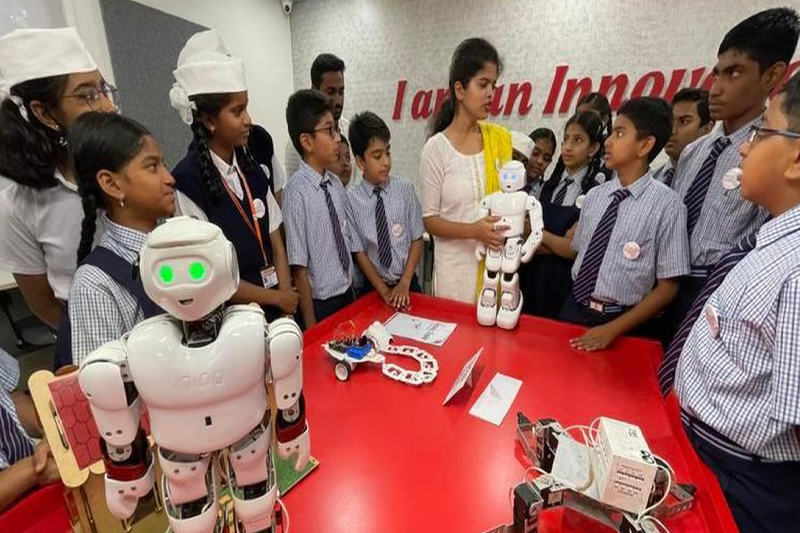
Delhi Students Showcase Tech-Driven and Social Innovation Projects at NEEEV Event
New Delhi witnessed a vibrant display of student ingenuity as young innovators from Delhi government schools presented their tech-driven and social innovation projects at the NEEEV zonal-level event. The event, aimed at fostering entrepreneurial thinking among students, was held at Sarvodaya Kanya Vidyalaya, Moti Bagh, with Delhi Education Minister Ashish Sood attending as the chief guest.
The NEEEV initiative, or New Era of Entrepreneurial Ecosystem and Vision, encourages students to develop practical, technology-based solutions for real-world challenges. During the event, 46 students selected from different zones showcased projects spanning Artificial Intelligence (AI) prototypes, low-cost technological solutions, and ideas addressing everyday social issues, reflecting the creativity and problem-solving skills nurtured under the program.
Minister Ashish Sood Encourages Young Entrepreneurs
Addressing the gathering, Education Minister Ashish Sood lauded the students for their innovative ideas, stating that such initiatives are crucial for making education practical, skill-oriented, and future-ready. He highlighted the recent startup boom in India, noting that over two lakh startups operate across the country today and emphasizing that the NEEEV programme prepares students to contribute to this innovation-driven ecosystem.
Sood revealed that during the current academic year, nearly 1.5 lakh students across around 1,000 Delhi government schools worked on more than 30,000 entrepreneurial ideas, with multiple teams encouraged per school. Out of these, approximately 4,829 teams were selected and provided with financial support of ₹20,000 each to develop prototypes, amounting to a total investment of nearly ₹10 crore.
“This support is not about ensuring every idea succeeds but about building confidence in children that their ideas matter and that the government stands with them,” Sood remarked. He noted that students are not only learning about AI but also developing AI-based prototypes, integrating innovation into everyday conversations at school and at home.
Next Phase: Scientific Validation and Industry Collaboration
Sood explained that the next phase of NEEEV would involve scientific validation of student innovations through collaboration with technical institutions and laboratories. This step ensures that promising ideas move beyond the conceptual stage into practical, implementable solutions.
Describing NEEEV as a flagship initiative of the Delhi government, Sood noted that it was launched in September 2025 to institutionalize entrepreneurship education for students from Classes 8 to 12, in alignment with the National Education Policy 2020.
The programme includes:
- A structured in-class curriculum integrating entrepreneurship concepts into daily learning
- NEEEV Dialogue, a speaker interaction series connecting students with entrepreneurs and industry experts
- The Startup Stormers innovation competition, encouraging students to turn ideas into functional prototypes
- Skill-based workshops designed to provide practical hands-on experience
- Industry exposure visits to companies and incubation centers
- A three-tier innovation council system at school, zonal, and district levels to monitor and support student projects
Extensive Outreach and Training
According to official statements, the NEEEV initiative has already trained over 16,700 stakeholders, including teachers, coordinators, and mentors, to implement the programme effectively. More than 2,000 dialogue sessions with entrepreneurs and industry experts have been conducted to inspire and guide students in turning their ideas into actionable projects.
Additionally, around 1,338 skill-based workshops have benefitted over 52,000 students, equipping them with specialized skills in technology, problem-solving, and entrepreneurship. Structured visits have been organized to universities, incubation centers, and major industries such as Hero MotoCorp, Maruti Suzuki, and Toshiba, giving students real-world exposure to innovation ecosystems.
Encouraging State-Level Recognition
The Startup Stormers competition, a core component of NEEEV, will continue to identify and support student innovations. About 150 student teams will be selected at the state level later this year for recognition and further opportunities to develop their projects. This final phase ensures that exceptional ideas receive additional resources, mentoring, and potential pathways for real-world application.
The initiative not only fosters technological and entrepreneurial skills but also cultivates leadership, teamwork, and problem-solving capabilities, preparing students to become innovators and changemakers in society.
Support from Other Government Leaders
Apart from the Education Minister, Delhi’s Social Welfare Minister Ravinder Indraj Singh actively participated in the zonal NEEEV event at CM Shri School, Rohini. He interacted with students, acknowledging their creativity and encouraging the development of their leadership qualities, social responsibility, and entrepreneurial skills. Such engagements underscore the government’s commitment to nurturing a generation of student innovators equipped to tackle social and technological challenges.
NEEEV: Building an Entrepreneurial Ecosystem
The NEEEV initiative goes beyond traditional classroom learning by integrating entrepreneurship education into the school curriculum. Students are encouraged to identify real-world problems, develop solutions using technology, and pitch their ideas confidently to stakeholders. This approach ensures that students acquire practical experience alongside academic knowledge, making education more relevant and aligned with future career demands.
By connecting students with industry experts, entrepreneurs, and technical institutions, NEEEV bridges the gap between classroom learning and the professional world, giving young innovators a clear understanding of the innovation lifecycle from concept to implementation.
Transforming Innovation in Schools
Over the current academic year, the NEEEV initiative has fostered a culture where innovation becomes part of daily learning and family discussions, inspiring students to think creatively and explore entrepreneurial opportunities. From AI-based projects to solutions addressing social challenges, students are learning that their ideas can have tangible impacts on society.
The structured programme, extensive mentorship, and financial support ensure that even small-scale ideas receive the attention needed to develop prototypes and demonstrate proof-of-concept. The initiative demonstrates how early exposure to entrepreneurship can build confidence, critical thinking, and problem-solving skills among schoolchildren.
Conclusion: NEEEV as a Model for Future Innovation
The NEEEV zonal-level event in Delhi exemplifies how government-supported initiatives can empower students to innovate, create, and solve real-world problems. With structured guidance, financial support, and industry exposure, students are gaining the tools to become the next generation of entrepreneurs, technologists, and socially responsible leaders.
By fostering innovation at the school level, the Delhi government is creating a pipeline of skilled, creative, and entrepreneurial students ready to contribute to India’s growing startup ecosystem. Initiatives like NEEEV highlight the importance of practical, skill-oriented education, making students not only academically proficient but also future-ready innovators.