Education Minister Dharmendra Pradhan Launches 55 New Books Celebrating Literary Works and Classical Languages
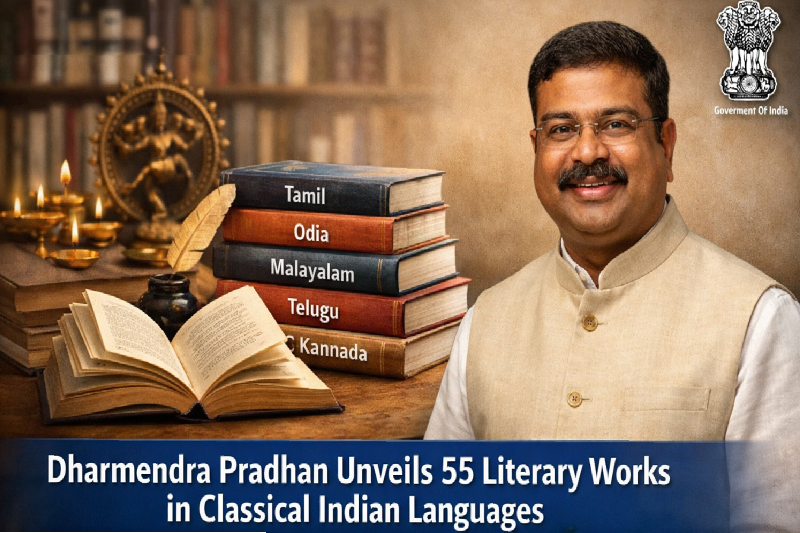
In a major initiative to promote India’s linguistic and literary heritage, Union Education Minister Dharmendra Pradhan recently announced the release of 55 new books, spanning literary works, classical languages, and even Sign Language interpretations of a Tamil classic. This move underscores the government’s commitment to preserving, promoting, and popularising India’s rich literary traditions, reflecting the nation’s cultural diversity and educational priorities.
The announcement comes shortly after Pradhan’s release, on Monday, of a special compilation of Prime Minister Narendra Modi’s Independence Day addresses from 2014 to 2025, translated into Urdu. Together, these initiatives highlight a broader strategy to bring India’s linguistic and cultural heritage into contemporary education and public discourse.
A Diverse Collection of Publications
The 55 newly released publications include:
- 41 literary works across regional languages
- 13 titles on classical languages
- A 45-episode Sign Language interpretation of the Tirukkural, produced by the Central Institute of Classical Tamil (CICT)
The Tirukkural, authored by the Tamil poet Thiruvalluvar, is one of India’s most revered classical texts. Comprising couplets that address ethics, governance, economics, and love, the Tirukkural serves as a timeless guide to human conduct and societal principles. By making these works accessible in Sign Language, the initiative also reinforces inclusivity and accessibility in preserving classical literature.
Celebrating India’s Linguistic Heritage
Speaking about the significance of the releases, Minister Pradhan highlighted how these publications represent a larger national effort to place India’s linguistic heritage at the centre of education, research, and cultural pride. The newly released literary works span Kannada, Telugu, Malayalam, Odia, Tamil, and Sign Language, reflecting the diversity of India’s languages.
“Delighted to release 55 scholarly volumes in classical Indian languages, including the interpretation of Tirukkural in Sign Language. These works are part of our broader national mission to strengthen India’s linguistic heritage in education, research and cultural consciousness,” Pradhan wrote in a post on X.com.
Pradhan also emphasised the unifying power of Indian languages, echoing Prime Minister Narendra Modi’s view that all Indian languages are national languages. By supporting education, research, and cultural initiatives in multiple languages, the government aims to nurture a sense of shared identity while celebrating India’s pluralistic linguistic landscape.
Preserving Literary Traditions
The Education Minister noted that the government is actively working to popularise and preserve India’s literary heritage. Indian languages, he said, are mediums of expression, creativity, and thought, and ensuring their continuity is central to cultural policy.
“We are working towards popularising and preserving India’s literary heritage. Indian languages are a medium of expression, and the government is committed towards these languages,” Pradhan stated.
This perspective aligns with broader efforts to strengthen classical language scholarship, promote regional literature, and encourage educational initiatives that integrate India’s linguistic diversity into mainstream learning.
Previous Release: Modi’s Independence Day Addresses in Urdu
Earlier, on Monday, Pradhan had released a book compiling Prime Minister Narendra Modi’s Independence Day speeches from 2014 to 2025, translated into Urdu. This publication has been brought out by the National Council for Promotion of Urdu Language (NCPUL), an autonomous body under the Ministry of Education.
The NCPUL plays a critical role in promoting, preserving, and propagating Urdu across the country, and this book exemplifies the council’s efforts to make prominent national narratives accessible in regional languages. By translating these addresses, the government aims to broaden public engagement, encourage literacy in Urdu, and make historical and political discourse more inclusive.
Significance of the Tirukkural in Modern Education
One of the highlights of Pradhan’s recent releases is the 45-episode Sign Language interpretation of the Tirukkural. This initiative reflects an inclusive approach to classical literature, ensuring that students and scholars with hearing impairments can also access India’s timeless texts.
The Tirukkural’s universal themes—ethics, governance, economics, and love—remain highly relevant today. By integrating Sign Language into its study and interpretation, the government is promoting equitable access to knowledge while fostering cultural awareness among a wider audience.
Strengthening Research and Cultural Consciousness
By launching books in multiple classical languages, including Kannada, Telugu, Malayalam, Odia, and Tamil, the Education Ministry aims to stimulate research, scholarship, and academic engagement with India’s linguistic heritage. These publications are not just literary works; they also serve as resources for educators, students, and researchers to explore classical texts, regional narratives, and multilingual literary traditions.
Pradhan highlighted that these efforts are part of a larger national mission to ensure that India’s linguistic and cultural wealth is integrated into education and made accessible to a broad audience. By emphasizing scholarly works and classical languages, the government aims to strengthen cultural consciousness among younger generations.
Indian Languages as a Unifying Force
A key theme in Pradhan’s address was the unifying potential of Indian languages. With hundreds of languages spoken across India, linguistic diversity can sometimes appear fragmented. However, initiatives like these demonstrate that languages are not barriers but connectors, fostering understanding, dialogue, and a sense of national identity.
“Indian languages serve as a unifying force, and all Indian languages are national languages. Promoting literature and classical texts ensures that our cultural heritage is preserved for future generations,” Pradhan said.
Conclusion: Celebrating India’s Literary Legacy
The release of 55 new books by Education Minister Dharmendra Pradhan marks a significant milestone in India’s efforts to preserve, promote, and popularize its linguistic and literary heritage. By covering literary works, classical languages, and Sign Language interpretations, these publications not only celebrate India’s diverse cultures but also encourage inclusive education, academic research, and cultural consciousness.
Earlier initiatives, such as the Urdu translation of Prime Minister Modi’s Independence Day addresses, reinforce the government’s commitment to making knowledge accessible across linguistic communities.
Through these efforts, the Ministry of Education is fostering a national mission that places Indian languages at the heart of education, research, and cultural pride. By encouraging students, scholars, and the public to engage with classical texts and regional literature, the initiative ensures that India’s rich literary legacy continues to inspire future generations.