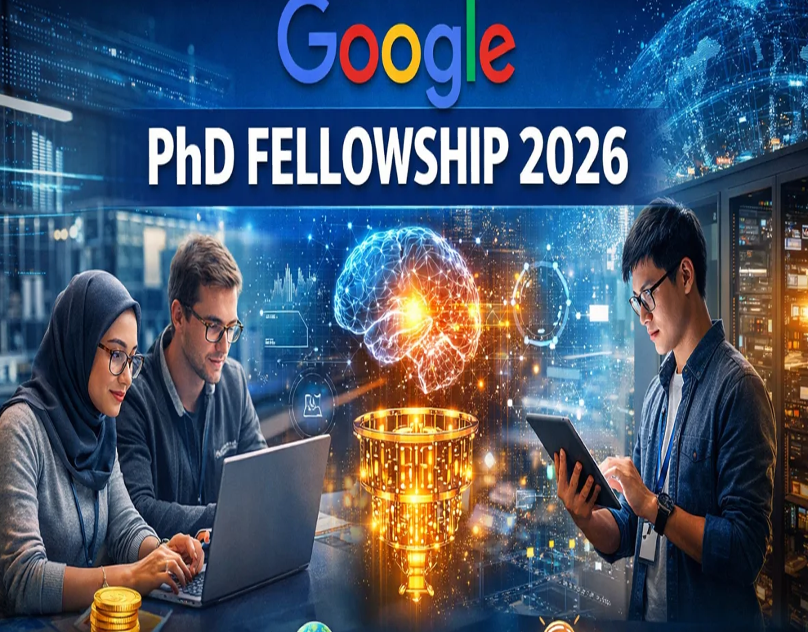
Google Opens PhD Fellowship 2026 Applications, Offers Up to $50,000 Funding for Indian Researchers
Google opens PhD Fellowship 2026 applications; up to USD 50,000 for to Indian researchers
In an era increasingly defined by knowledge economies and technological advancement, the cultivation of research talent has become a strategic imperative. Against this backdrop, the announcement of the Google PhD Fellowship Programme 2026 marks a significant opportunity for Indian scholars seeking to contribute to cutting-edge innovation. With financial support of up to USD 50,000, the fellowship underscores a growing synergy between global technology leaders and academic research ecosystems.
More than a mere funding initiative, the programme represents a recognition of intellectual promise, an investment in individuals whose work may shape the future of computing and allied disciplines.
A Fellowship Rooted in Academic Excellence
The Google PhD Fellowship Programme has long been positioned as a prestigious platform designed to recognise outstanding graduate students engaged in innovative research. It is specifically tailored for those working in computer science and closely related fields, where the pace of discovery continues to accelerate.
For Indian researchers, the 2026 cycle offers not only financial assistance but also validation on a global stage. The fellowship seeks candidates who demonstrate exceptional academic achievement, a strong research trajectory and the potential to influence technological progress in meaningful ways.
Such initiatives reflect a broader trend in which private sector organisations actively support academic inquiry, acknowledging that the boundaries between academia and industry are increasingly porous.
Financial Support and What It Covers
At the heart of the fellowship lies its substantial financial offering. Indian PhD scholars can receive funding of up to USD 50,000, intended to support a range of academic and research-related expenses.
This support typically encompasses stipends, research costs, and travel expenses, including opportunities for international collaboration. For early-stage PhD students, the funding may extend over multiple years, providing sustained backing during critical phases of research.
In a research environment often constrained by limited resources, such financial assistance can be transformative. It enables scholars to focus more fully on intellectual pursuits, reducing the burden of financial uncertainty.
The Nomination-Based Application Process
One of the distinguishing features of the Google PhD Fellowship is its nomination-based application process. Unlike conventional scholarships, students cannot apply directly. Instead, they must be nominated by their respective universities, with each institution permitted a limited number of nominations.
This approach introduces an additional layer of selectivity. Universities are tasked with identifying their most promising candidates, thereby ensuring that nominations reflect both academic merit and institutional endorsement.
While this may appear restrictive, it also enhances the fellowship’s credibility. Being nominated becomes, in itself, a mark of distinction, an acknowledgment of a student’s potential by their academic community.
Timeline and Key Dates
The application window for the 2026 fellowship cycle opened earlier in March and will remain active until April 30, 2026.
Following the submission of nominations, proposals will undergo a rigorous evaluation process. Decisions are expected by the end of August, with final selections publicly announced by October.
This structured timeline allows for comprehensive assessment, ensuring that selected candidates meet the programme’s high standards of excellence.
Areas of Research and Academic Scope
The fellowship spans a wide array of research domains within computer science and its adjacent disciplines. These include, but are not limited to, machine learning, algorithms, computer architecture, natural language processing and human-computer interaction.
Such diversity reflects the evolving nature of technology, where interdisciplinary approaches are increasingly essential. Researchers are encouraged to explore innovative ideas that address complex, real-world challenges - whether in artificial intelligence, healthcare technology or data science.
By supporting work across these varied fields, the fellowship fosters a dynamic research environment that is both expansive and forward-looking.
Selection Criteria: Beyond Academic Scores
Selection for the Google PhD Fellowship is far from a purely quantitative exercise. While academic excellence remains a fundamental criterion, evaluators also consider the originality and impact of the candidate’s research, as well as their leadership potential.
This holistic approach acknowledges that meaningful research is not solely the product of technical proficiency. It requires creativity, intellectual curiosity and the ability to engage with broader societal questions.
Candidates are thus assessed not only on what they have achieved, but on what they are capable of contributing in the future.
Implications for Indian Research Ecosystem
The inclusion of India as a key region in the fellowship programme carries significant implications. It reflects the country’s growing prominence in global research and technology landscapes, as well as the increasing quality of its academic institutions.
For Indian universities, the fellowship offers an opportunity to strengthen their research credentials and foster a culture of excellence. By nominating candidates, institutions actively participate in shaping the next generation of scholars.
For students, the programme provides access to resources and recognition that can elevate their academic and professional trajectories.
Bridging Academia and Industry
Perhaps one of the most compelling aspects of the Google PhD Fellowship is its role in bridging academia and industry. While recipients are not employed by Google, they gain exposure to a broader research ecosystem that includes leading experts and cutting-edge developments.
This connection facilitates knowledge exchange and opens avenues for collaboration, internships, and future career opportunities. It also ensures that academic research remains aligned with real-world applications, enhancing its relevance and impact.
In this sense, the fellowship serves as a conduit between theoretical inquiry and practical innovation.
Challenges and Considerations
Despite its many advantages, the fellowship is not without its challenges. The nomination-based process can limit access, particularly for students in institutions with fewer resources or less established research cultures.
Moreover, the highly competitive nature of the programme means that only a small fraction of applicants will ultimately be selected. This underscores the importance of early preparation, strong academic performance and a well-defined research agenda.
Candidates must also navigate the complexities of securing institutional nomination, which may involve internal selection processes and additional requirements.
Preparing for a Strong Nomination
For aspiring candidates, preparation begins well before the application window. Building a strong academic record, engaging in meaningful research projects and cultivating relationships with faculty mentors are essential steps.
Equally important is the development of a clear and compelling research proposal. This should articulate not only the technical aspects of the work, but also its broader significance and potential impact.
Letters of recommendation, often required as part of the nomination, play a crucial role in conveying a candidate’s capabilities and character.
A Broader Reflection on Opportunity
In many ways, the Google PhD Fellowship represents more than a scholarship, it is a symbol of the evolving relationship between knowledge, innovation and global collaboration.
As technology continues to reshape societies, the need for thoughtful, ethical, and impactful research has never been greater. Programmes such as this recognise that the solutions to tomorrow’s challenges will emerge from today’s laboratories and classrooms.
For Indian researchers, the fellowship offers not only financial support but also a platform to contribute to this larger narrative.
Conclusion
The opening of applications for the Google PhD Fellowship Programme 2026 is a timely reminder of the opportunities available to those who combine intellectual rigour with creative ambition. With a deadline set for April 30, aspiring candidates must act with both urgency and deliberation.
In a competitive academic environment, distinctions such as this fellowship can serve as powerful catalysts, shaping careers and advancing research in meaningful ways.
Ultimately, the programme reflects a simple yet profound truth: that investing in people - curious, committed and capable individuals, is the most effective way to advance knowledge and, by extension, society itself.