SAU–Nalanda Agreement Opens New Chapter in South Asian Academic Cooperation
A New Chapter in Academic Diplomacy: SAU–Nalanda MoU Signals a Shift in Collaborative Higher Education
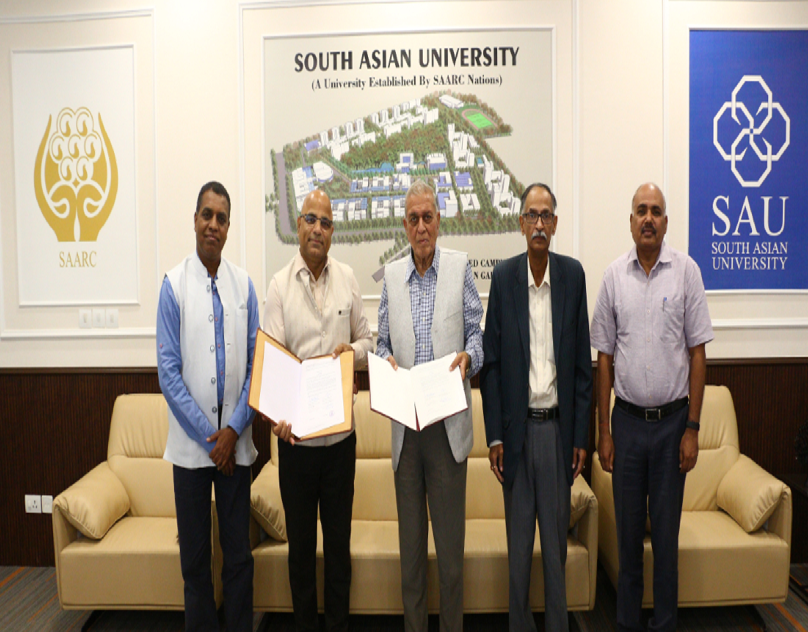
In an era increasingly defined by global knowledge exchange and interdisciplinary learning, partnerships between universities are no longer optional; they are essential. The recent Memorandum of Understanding (MoU) signed between South Asian University and Nalanda University marks a significant step in this direction. The agreement, formalised at Nalanda’s Rajgir campus, aims to deepen collaboration in academic and research domains, offering a renewed vision for higher education in South Asia.
This development is not merely a ceremonial gesture but a strategic alignment between two institutions that share a commitment to intellectual excellence, regional integration and global academic engagement.
The Context: Universities as Hubs of Regional Collaboration
Higher education institutions today are increasingly viewed as catalysts for regional cooperation. Universities are not only centres of learning but also platforms for dialogue, innovation and cultural exchange.
South Asian University, established under the aegis of the South Asian Association for Regional Cooperation (SAARC), embodies this ethos by bringing together students from across South Asia. Meanwhile, Nalanda University, revived as a modern institution rooted in an ancient legacy, serves as a symbol of India’s intellectual heritage and its global aspirations.
The MoU between these two institutions thus represents a convergence of regional vision and historical significance, reinforcing academia's role in fostering cross-border collaboration.
What the MoU Entails
At its core, the agreement outlines a comprehensive framework for academic and research cooperation. The partnership is designed to facilitate joint initiatives that extend beyond conventional academic boundaries.
Key areas of collaboration include joint research supervision, teaching programmes, postdoctoral opportunities, and academic events such as conferences and symposiums. These initiatives aim to create a dynamic academic environment where knowledge is co-created and shared.
Equally significant is the emphasis on mobility; both institutions have committed to enabling the exchange of faculty, researchers and students. This exchange is expected to enrich academic perspectives, allowing participants to benefit from diverse intellectual traditions and methodologies.
The agreement also provides for the sharing of academic resources, further strengthening the collaborative framework. Such resource sharing can include access to research facilities, libraries and digital platforms, thereby enhancing the overall quality of education and research.
Leadership Perspectives: A Shared Vision
The significance of the MoU is underscored by the perspectives of institutional leaders. The agreement was signed by Professor K K Aggarwal, President of SAU and Professor Sachin Chaturvedi, Vice-Chancellor of Nalanda University.
Professor Aggarwal highlighted the potential of the partnership to expand collaboration across academic and research domains, creating meaningful opportunities for students. His remarks reflect a forward-looking approach in which institutional collaboration is seen as a means of empowering the next generation of scholars.
Professor Chaturvedi described the MoU as a “new beginning” in academic engagement, emphasising its role in exposing students to best practices and intellectual resources from both universities. This perspective underscores the transformative potential of such partnerships in shaping academic experiences.
Bridging Tradition and Modernity
One of the most compelling aspects of this collaboration lies in its ability to bridge tradition and modernity. Nalanda University, with its historical roots tracing back to one of the world’s oldest centres of learning, represents a legacy of scholarship that spans centuries.
In contrast, South Asian University embodies a contemporary vision of regional cooperation, bringing together students and faculty from multiple countries.
The MoU effectively brings these two dimensions together, creating a platform where ancient wisdom meets modern academic practices. This synthesis is particularly relevant in today’s context, where interdisciplinary and cross-cultural approaches are increasingly valued.
The Role of Interdisciplinary Learning
A defining feature of the collaboration is its emphasis on interdisciplinary learning. Modern challenges, ranging from climate change and public health to economic development and technological innovation, cannot be addressed through isolated disciplines.
By fostering joint research and academic programmes, the MoU encourages scholars to engage with complex issues from multiple perspectives. Conferences, symposiums, and collaborative projects will provide opportunities for dialogue and knowledge exchange, enabling participants to develop holistic solutions.
This focus on interdisciplinarity aligns with global trends in higher education, where integrating diverse fields is seen as essential for innovation and problem-solving.
Opportunities for Students and Researchers
For students, the partnership opens up a wealth of opportunities. Exchange programmes will allow them to experience different academic environments, interact with peers from diverse backgrounds and gain exposure to new ideas.
Such experiences are invaluable in shaping well-rounded individuals who are equipped to navigate an increasingly interconnected world. Access to shared academic resources further enhances the learning experience, providing students with tools and perspectives that extend beyond their home institutions.
Researchers, too, stand to benefit significantly. Collaborative projects and joint supervision arrangements can lead to more robust and impactful research outcomes. By pooling expertise and resources, the institutions can undertake ambitious projects that might not be feasible individually.
Strengthening South Asia’s Academic Ecosystem
Beyond individual benefits, the MoU has broader implications for the region’s academic ecosystem. South Asia, with its rich intellectual traditions and diverse cultures, has immense potential to emerge as a global hub for education and research.
Collaborations such as this play a crucial role in realising that potential. By fostering connections between institutions, they create networks of knowledge that transcend national boundaries.
The partnership between South Asian University and Nalanda University is particularly significant in this context, as it brings together institutions that are inherently international in their outlook.
Challenges and the Road Ahead
While the MoU represents a promising development, its success will depend on effective implementation. Institutional collaborations often face challenges related to coordination, funding and administrative processes.
Ensuring that the outlined initiatives translate into tangible outcomes will require sustained effort and commitment from both sides. Regular monitoring, clear communication, and a shared sense of purpose will be essential in overcoming potential obstacles.
At the same time, the evolving nature of higher education presents both opportunities and challenges. As digital technologies reshape the academic landscape, institutions must adapt to new modes of teaching, learning and collaboration.
A Step Towards Academic Diplomacy
The SAU–Nalanda MoU can also be viewed through the lens of academic diplomacy. In a world marked by geopolitical complexities, educational collaborations offer a constructive avenue for engagement and cooperation.
By bringing together scholars and students from different countries, such partnerships foster mutual understanding and respect. They create spaces for dialogue and exchange, contributing to a more inclusive and interconnected global community.
In this sense, the MoU extends beyond academia, reflecting a broader vision of regional harmony and cooperation.
Conclusion
The agreement between South Asian University and Nalanda University marks a significant milestone in the evolution of higher education in South Asia. It embodies a forward-thinking approach that recognises the value of collaboration, interdisciplinarity and global engagement.
As the partnership unfolds, its true impact will be measured not only by academic output but also by the opportunities it creates for students, researchers, and institutions. By fostering a culture of shared learning and mutual growth, the MoU has the potential to redefine the contours of higher education in the region.
In an increasingly interconnected world, such collaborations are not merely desirable; they are indispensable.