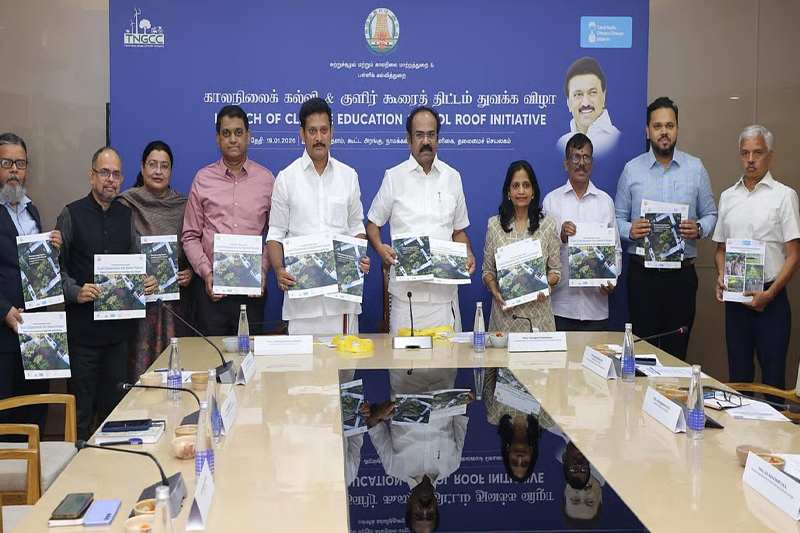
Tamil Nadu Leads the Way by Blending Climate Education with Cool Roof Infrastructure Across 300 Green Schools
The Government of Tamil Nadu has taken a decisive and forward-looking step in addressing climate change by integrating climate education with heat-resilient infrastructure across 300 Green Schools. Launched on January 19, 2026, this expanded Climate Education and Cool Roof initiative positions Tamil Nadu as a national frontrunner in embedding sustainability into public education while responding pragmatically to the growing threat of extreme heat.
The initiatives were formally inaugurated by the Minister for Finance and Environment, Climate Change, Thiru. Thangam Thennarasu, along with the Minister for School Education, Thiru. Anbil Mahesh Poyyamozhi. The launch underscored the state’s commitment under the Tamil Nadu Climate Change Mission to transform schools into spaces that not only impart knowledge, but also actively demonstrate climate resilience and environmental responsibility.
Climate Education Embedded in Everyday Learning
At the core of the programme is the Climate Education Initiative, now mainstreamed across Tamil Nadu’s school system and announced in the 2025–26 State Budget. Rather than limiting climate change to textbooks, the initiative turns school campuses into “living laboratories” where students actively engage with real-world environmental challenges.
Students participate in hands-on learning experiences covering climate change, natural resource management, biodiversity, and sustainability. These include residential teacher training programmes, student nature camps, and the statewide Soozhal Arivom climate quiz, all designed to foster inquiry, awareness, and action. Through these activities, climate literacy becomes experiential, encouraging students to observe, question, and respond to environmental issues within their own communities.
Teachers as Climate Ambassadors
A major pillar of the initiative is capacity building among educators. The state has committed to training 4,000 teachers from all 38 districts as volunteer Climate Ambassadors, with at least 50 per cent drawn from government and government-aided schools. These ambassadors will play a crucial role in integrating climate perspectives into everyday teaching and inspiring students to adopt environmentally responsible behaviours.
During the launch event, the Training of Teachers (ToT) module was officially released. The first certified residential training programme began on January 20, 2026, in Salem, with 210 teachers participating in the inaugural cohort. Once trained, these educators will act as multipliers, spreading climate awareness and encouraging student-led initiatives across schools.
Addressing Heat Stress Through Cool Roofs
Alongside climate education, Tamil Nadu is tackling one of the most pressing barriers to learning: extreme heat. With rising summer temperatures, many concrete-roofed government schools experience indoor temperatures of 38–40 degrees Celsius during peak hours. Research shows that temperatures above 30–32 degrees Celsius significantly impair concentration, learning outcomes, and exam performance. Recognising this, Tamil Nadu has declared heat a State-specific disaster.
To mitigate heat stress, the state has integrated the Cool Roof initiative into the 2025–26 Tamil Nadu Climate Change Mission Action Plan. The initiative uses heat-reflective roof coatings to reduce the amount of solar heat absorbed by school buildings, offering a low-cost and energy-efficient solution.
The pilot project at Ambattur Perunthalaivar Kamarajar Government Girls Higher Secondary School demonstrated the effectiveness of this approach. Post-intervention data showed average indoor temperature reductions of 3–4 degrees Celsius, ceiling surface temperature drops of 4–5 degrees Celsius, and occupied-hour classroom temperatures falling from 31–32 degrees Celsius to around 27 degrees Celsius. These improvements significantly enhanced thermal comfort while reducing reliance on fans and air conditioning.
Expanding the Cool Roof Model
The statewide expansion of cool roofs was marked by inaugurations at Chennai Girls Higher Secondary School, Shenoy Nagar, and Chennai Higher Secondary School, Thiruvanmiyur. In recognition of exemplary climate-responsive design, Green School Certificates were awarded to Ambattur Perunthalaivar Kamarajar Government Girls Higher Secondary School and Kollumedu Government Higher Secondary School in Tiruvallur district.
By improving classroom comfort, the Cool Roof initiative directly supports student wellbeing, attendance, and learning outcomes—demonstrating how infrastructure interventions can complement educational reform.
Evidence-Based Expansion Through Knowledge Resources
To guide the scaling of these initiatives, the government released three key publications that provide data-driven insights and practical frameworks.
The first, Impact Study of the Tamil Nadu Green School Scheme, developed in collaboration with the Indian Institute for Human Settlements (IIHS), reframes the Green School programme as a climate literacy initiative rather than a purely infrastructure-focused scheme. Starting with 25 pilot schools, the programme has now expanded to 300 schools. Rooftop solar installations have reduced grid electricity consumption by 46 per cent per school, saving an average of 3,572 kWh and ₹2.26 lakh annually. The study estimates that scaling this model to all 45,000 government schools could offset 91 per cent of electricity use across educational and health institutions. Importantly, behavioural change is already visible, with nearly half of participating schools running structured climate campaigns.
The second publication, Mainstreaming Passive Cooling in Green Schools: Learning from Tamil Nadu’s Cool Roof Initiative, developed with the United Nations Environment Programme (UNEP), positions cool roofs as an affordable, rapidly deployable response to extreme heat. Even modest indoor temperature reductions of 4–8 degrees Celsius have been shown to improve focus and learning outcomes, while also reducing urban heat island effects. Under UNEP’s Be Cool Programme, thermal comfort audits and passive design training are being rolled out statewide.
The third resource, Cool Classrooms, Green Futures – Passive Cooling Solutions for Tamil Nadu Green Schools, provides a comprehensive framework combining cool roofs, shading, ventilation, and greenery. When implemented together, these measures can reduce roof temperatures by 10–15 degrees Celsius, lower indoor temperatures by 2–4 degrees Celsius, and cut cooling energy demand by up to 70–80 per cent.
Building Climate-Ready Schools for the Future
These initiatives build on Tamil Nadu’s broader climate leadership, which includes widespread solar adoption in schools, wetland restoration projects, and the formal recognition of heat as a disaster risk. By equipping teachers with knowledge, cooling classrooms with practical solutions, and empowering students through experiential learning, the state is laying the foundation for long-term climate resilience.
Tamil Nadu’s approach demonstrates that climate action in education does not have to be fragmented. By aligning curriculum, infrastructure, and community engagement, schools are becoming active centres of sustainability. As temperatures rise and climate challenges intensify, this integrated model ensures that schools remain safe, comfortable spaces for learning—while nurturing a generation prepared to lead in a warming world.