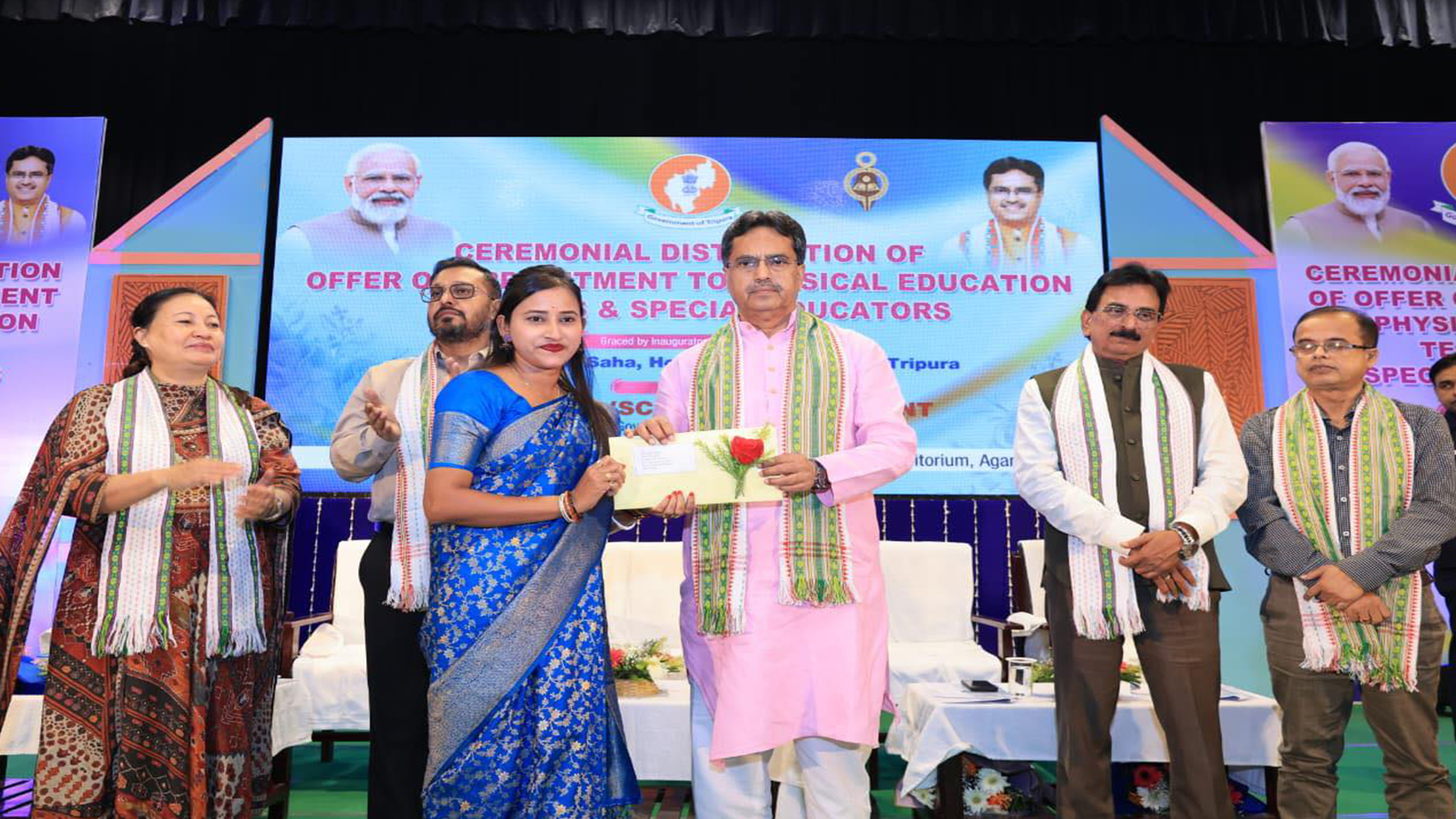
Tripura Government Prioritizes Merit-Based Recruitment and Education Reforms: CM Manik Saha
Tripura Chief Minister Manik Saha has reaffirmed the state government’s commitment to transparent recruitment and the holistic development of the education and health sectors. Speaking at an event for the distribution of appointment letters to newly recruited staff, CM Saha emphasized that qualifications, not political affiliations, determine eligibility for government jobs in the state. This statement underscores Tripura’s ongoing effort to ensure fair employment practices while strengthening key public sectors.
Merit-Based Recruitment: Ensuring Transparency
CM Saha highlighted that from the very beginning, the current administration has prioritized transparency in government recruitment processes. “No one can now claim that political affiliation is required to secure a government job. If one has the qualifications, it is definitely possible to get a job,” he asserted.
The Chief Minister shared that the government has successfully provided employment to 20,181 individuals across various departments, including positions filled under die-in-harness cases. A significant portion of these appointments—6,998 positions—have been made within the Education Department, covering PGT, GT, and UGT roles. These numbers reflect the administration’s focus on strengthening human resources in education and ensuring that qualified professionals are placed in critical roles.
CM Saha also mentioned that over 5,000 individuals have been appointed through contractual and outsourcing processes, providing flexibility to meet the state’s staffing needs while maintaining high standards of selection.
Event for Physical Education Teachers and Special Educators
The Chief Minister inaugurated the distribution of appointment letters for 102 Physical Education Teachers and 55 Special Educators under the School Education Department at the Muktadhara Auditorium. CM Saha personally handed letters to some of the recruits, symbolizing the government’s recognition of their achievements and the importance of merit in recruitment.
Senior officials present at the event included:
- Ravel Hemendra Kumar, Special Secretary of Education
- NC Sharma, Director of School Education
- Rajiv Dutta, Director of Basic Education
- L Darlong, Director of SCERT
The presence of top officials emphasized the administration’s commitment to fair recruitment practices and capacity-building within the education sector.
Focus on Quality Education
CM Saha stressed that improving the quality of education remains a top priority for the state government. “Our aim is to ensure that students receive quality education in a friendly and supportive environment. The appearance and demeanour of those who received appointment letters today show that they are deserving candidates,” he said.
Under the guidance of Prime Minister Narendra Modi, Tripura has implemented several initiatives aligned with the National Education Policy (NEP), aiming to revive India’s traditional educational values while modernizing teaching and learning practices.
State-Level Educational Reforms
CM Saha detailed several key reforms and initiatives undertaken to enhance education in Tripura:
- Nipun Tripura: Focused on improving foundational literacy and numeracy skills among students.
- CM Saath: Aimed at providing personalized support and mentorship to students.
- Mission Mukul and Saharsha: Programs designed to improve academic outcomes and ensure holistic student development.
- Vidya Jyoti and PM-Shri Schools: 125 schools converted into Vidya Jyoti institutions and 84 schools into PM-Shri schools to provide modern infrastructure, teaching resources, and enhanced learning environments.
- CM Kanya Atmanirbhar Yojana: A flagship initiative to empower girl students and promote gender equality in education.
These programs reflect the government’s multi-pronged approach to education, combining infrastructural improvements, skill development, and inclusivity.
Higher Education Expansion
Beyond school-level reforms, Tripura has significantly expanded its higher education sector, creating opportunities for students across multiple disciplines. Institutions in the state now include:
- Medical Colleges: Three MBBS colleges along with nursing, ANM, and GNM colleges.
- Agriculture, Fishery, and Veterinary Colleges: Providing specialized professional education to meet regional development needs.
- Technical and Law Institutions: IIIT, National Law University, National Forensic Science University, and NIT Tripura.
- Private Universities: Offering diverse programs to cater to increasing demand for higher education.
As part of the Target Project, 10 aspirants have already received support to compete in national-level examinations, demonstrating the government’s commitment to fostering talent capable of achieving national recognition.
CM Saha’s Vision for Education and Governance
CM Saha’s remarks at the event reflect a broader vision for Tripura: transparent governance, merit-based recruitment, and quality education for all. By ensuring that qualified candidates secure government jobs, the administration aims to enhance efficiency in public services while boosting morale among educators and administrators.
The emphasis on merit over political connections is particularly significant in promoting fairness, inclusivity, and accountability within government operations. By providing proper employment opportunities to deserving candidates, Tripura is strengthening its human capital, particularly in sectors critical to social development such as education and health.
Conclusion
Tripura’s recent initiatives underscore the state government’s commitment to meritocracy, transparency, and educational excellence. From appointing hundreds of teachers and special educators to implementing innovative programs like Nipun Tripura, Mission Mukul, and Vidya Jyoti schools, CM Saha’s administration is focused on creating a robust, equitable, and high-quality educational ecosystem.