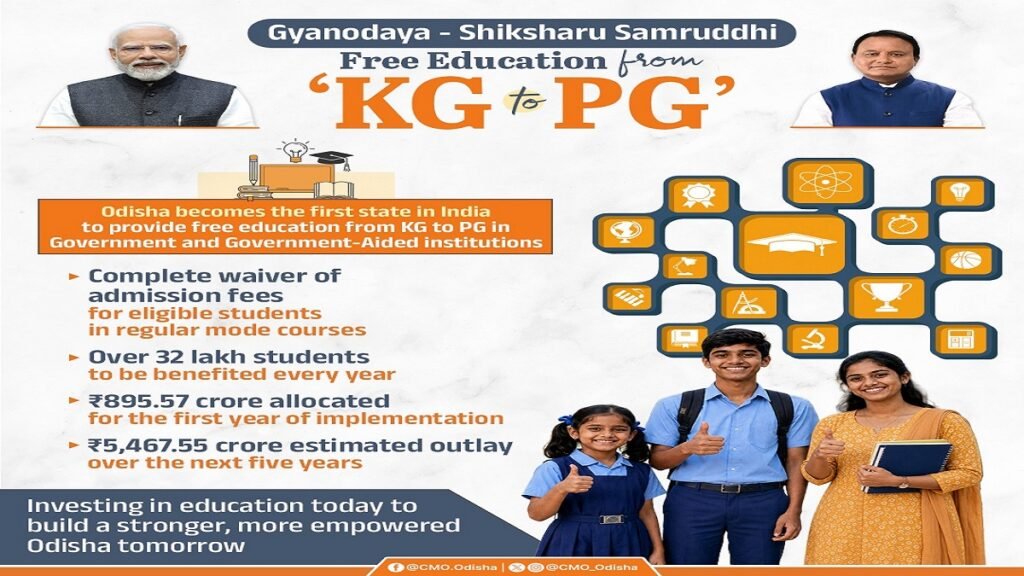
Education has long been recognised as the cornerstone of social and economic progress. In a landmark move that could redefine access to learning, the Odisha Cabinet has approved the Gyanodaya Scheme, introducing free education from KG to PG in government and government-aided educational institutions across the state. The initiative, which will come into effect from the 2026-27 academic session, is expected to benefit more than 32 lakh students annually by eliminating admission and enrolment fees.
The Odisha Cabinet’s approval of the Gyanodaya Scheme marks one of the most ambitious education reforms undertaken by any Indian state in recent years. Designed to make education accessible at every stage, from Kindergarten (KG) to Postgraduate (PG) level, the initiative seeks to ensure that financial constraints no longer prevent students from pursuing their academic aspirations. The scheme will apply to students studying in government and government-aided institutions managed by the School and Mass Education Department as well as the Higher Education Department. Since education up to Class VIII is already free in Odisha, the new policy effectively extends this benefit through secondary, undergraduate, and postgraduate education, creating a seamless pathway of publicly supported learning.
The newly approved policy offers substantial financial relief by waiving admission and enrolment fees for eligible students.
Some of the key highlights include:
- Free education from Kindergarten to Postgraduate level.
- Coverage of government and government-aided educational institutions.
- Benefits for over 32 lakh students every academic year.
- Implementation from the 2026-27 academic session.
- Multi-year financial commitment by the state government to support implementation.
By reducing the financial burden on families, the initiative is expected to encourage higher enrolment rates and improve educational continuity across different stages of learning.
Affordability remains one of the biggest challenges faced by many families seeking quality education. Although tuition support exists in several forms across India, admission-related expenses and institutional fees often discourage students from continuing their education beyond school. The introduction of free education from KG to PG addresses this issue directly. It creates opportunities for students from economically weaker sections to complete higher education without facing recurring financial obstacles.
The implementation of the Gyanodaya Scheme is expected to generate several positive outcomes for learners throughout the state.
Some anticipated benefits include:
- Reduced financial burden on parents.
- Improved enrolment in secondary and higher education.
- Lower student dropout rates.
- Greater access to undergraduate and postgraduate programmes.
- Enhanced educational equity across rural and urban communities.
- Better opportunities for first-generation learners.
For many families, especially those with multiple children, waiving institutional fees can significantly ease household expenses while encouraging continued education.
The decision aligns with India’s broader objective of improving educational accessibility and increasing participation in higher education.
By extending support beyond school education, Odisha is recognising that learning should not end after secondary school but continue into universities and postgraduate institutions. The initiative complements national efforts to strengthen higher education, promote lifelong learning, and improve the Gross Enrolment Ratio (GER).
As highlighted by TopEducationNews, such policies demonstrate how state governments can complement national education reforms by introducing region-specific initiatives that address local educational challenges.
Education is one of the most effective investments any government can make in long-term development. Better educational access contributes to improved employment opportunities, stronger economic productivity, and greater social mobility.
The Gyanodaya Scheme is expected to produce benefits extending beyond classrooms by:
- Developing a more skilled workforce.
- Encouraging higher participation in university education.
- Supporting regional economic development.
- Promoting social inclusion.
- Reducing educational inequality.
Over time, increased access to higher education may also strengthen research, innovation, entrepreneurship, and professional development across Odisha.
Click below to watch the video.
While the announcement has been widely welcomed, successful implementation will determine the scheme’s long-term impact.
To maximise its effectiveness, authorities will need to ensure:
- Timely release of institutional funding.
- Efficient administrative coordination.
- Transparent eligibility processes.
- Continuous monitoring of implementation.
- Adequate educational infrastructure to accommodate increased enrolment.
Maintaining academic quality alongside expanded access will remain an important priority as more students benefit from the programme.
The introduction of free education from KG to PG represents one of the most comprehensive state-supported education initiatives currently being implemented in India. If successfully executed, Odisha’s approach could inspire similar reforms in other states seeking to improve educational access and reduce financial barriers for students. Governments across the country are increasingly recognising that investment in education contributes directly to economic growth, human capital development, and social progress.
The Odisha Cabinet’s approval of the Gyanodaya Scheme represents a significant milestone in the journey towards universal and inclusive education. By extending free education from KG to PG across government and government-aided institutions, the state has demonstrated its commitment to ensuring that financial limitations do not stand in the way of learning.
With more than 32 lakh students expected to benefit each year, the initiative has the potential to improve enrolment, reduce dropout rates, and strengthen higher education participation across Odisha. If implemented effectively, it may well become a benchmark for educational reform across India.
As education policies continue to evolve, EducationTodayNews and TopEducationNews remain committed to bringing readers reliable insights into the latest developments shaping the future of learning, policy, and student success.