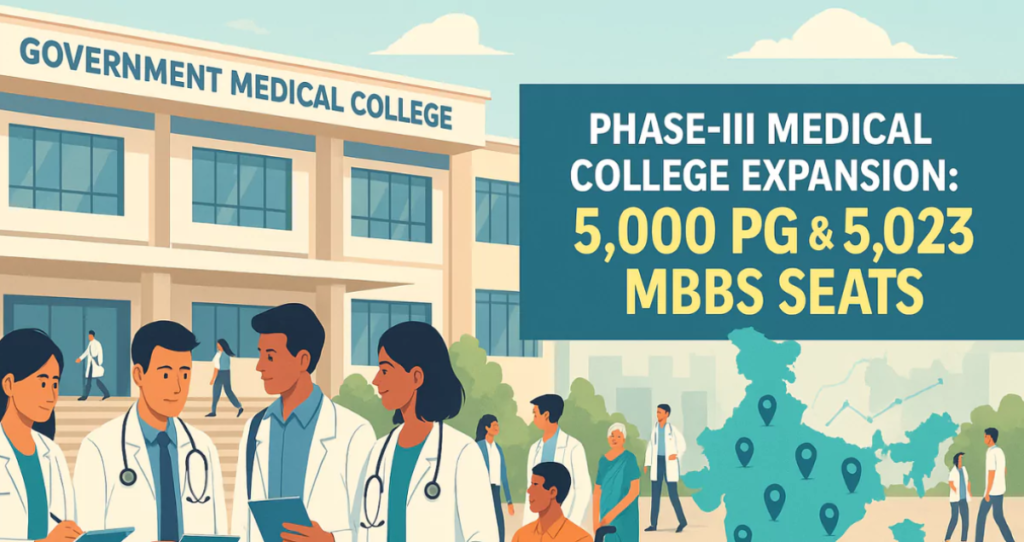
India’s medical education system is set to receive another significant capacity boost, with the Centre approving a plan to add 5,000 postgraduate medical seats by the 2028-29 academic year. The expansion comes at a time when the demand for specialist doctors continues to grow alongside the country’s expanding healthcare infrastructure.
According to the latest information shared by the government, India currently has 86,360 postgraduate medical seats. The proposed addition is expected to strengthen specialist training capacity and create more opportunities for medical graduates seeking advanced qualifications in disciplines such as medicine, surgery and other clinical specialities.
The move forms part of the third phase of the Centrally Sponsored Scheme aimed at strengthening and upgrading government medical colleges, standalone postgraduate institutes and government hospitals. The wider initiative also includes the addition of 5,023 undergraduate medical seats, taking the combined target to more than 10,000 new UG and PG seats by 2028-29.
Expanding the Specialist Doctor Pipeline
The growth of medical colleges and undergraduate seats over the past decade has increased the number of students entering the medical education system. However, the availability of postgraduate opportunities remains equally important because an MBBS qualification is only the beginning of a longer professional journey for many doctors.
Postgraduate education enables doctors to specialise and develop advanced clinical expertise. Increasing the number of postgraduate medical seats can therefore help create a stronger pipeline of specialists while giving more MBBS graduates an opportunity to pursue MD, MS and other recognised postgraduate programmes.
The Centre’s latest expansion plan is particularly relevant because specialist healthcare requires not only more doctors but also appropriately trained professionals across different branches of medicine. Expanding postgraduate capacity can support the development of expertise in areas where healthcare systems require greater specialist availability.
Inside the Medical Education Expansion
- India currently has 86,360 postgraduate medical seats
- The Centre plans to add 5,000 PG seats by 2028-29
- The expansion is being implemented under Phase III of the government’s medical education strengthening scheme
- A further 5,023 MBBS seats are also targeted under the broader expansion programme
- The initiative focuses on strengthening government medical colleges, postgraduate institutes and government hospitals
- The cost ceiling for creating each additional PG seat has been enhanced to ₹1.50 crore
Karnataka Leads in Postgraduate Capacity
The distribution of postgraduate medical education across the country is another important aspect of the development. Karnataka currently has the highest number of PG medical seats, with more than 10,000 seats reported across its medical institutions. This reflects the state’s established medical education ecosystem and the presence of several institutions offering specialist training.
The expansion, however, also raises a broader question about how new capacity should be distributed. Increasing seats in regions with substantial medical education infrastructure can strengthen existing centres, but expanding opportunities in underserved areas could help address geographical disparities in access to specialist healthcare.
For the policy to deliver its full impact, the number of seats will therefore need to be considered alongside infrastructure, faculty availability, hospital capacity and the quality of clinical training.
What It Means for NEET-PG Aspirants
For medical graduates, the most immediate significance of the announcement is the potential expansion of opportunities through NEET-PG admissions. Competition for postgraduate medical programmes has traditionally been intense, making every additional approved seat important for aspiring specialists.
However, an increase in seats should not be viewed simply as an increase in numbers. Postgraduate medical education involves intensive clinical exposure, experienced faculty, adequate patient load, laboratories and other institutional facilities. Ensuring these elements keep pace with the expansion will be essential.
The government has also indicated that the expansion is aligned with regulations of the National Medical Commission, which plays a central role in maintaining standards for medical education and training. The National Board of Examinations in Medical Sciences also continues to contribute to specialist training through its postgraduate pathways.
Why the Development Matters
For students, parents, educators and medical education professionals following developments through EducationToday, the announcement represents more than a numerical increase in seats. It signals a continuing shift towards expanding India’s specialist training capacity.
For aspiring doctors, the development could mean a wider range of opportunities after completing their undergraduate medical education. For institutions, it highlights the importance of developing infrastructure and academic capacity capable of supporting high-quality postgraduate training.
At the same time, the expansion places greater responsibility on medical institutions to ensure that additional seats translate into meaningful learning and clinical experiences. A larger intake without adequate faculty, hospital exposure or training facilities could weaken the very objective of capacity expansion.
Looking Beyond Seat Numbers
India’s medical education landscape has changed considerably over the past decade, with substantial growth in both medical colleges and available seats. The latest proposal represents another step in that continuing expansion.
Yet the long-term success of the initiative will depend on how effectively new seats are implemented. Specialist training must remain closely connected with healthcare requirements, regional needs and the availability of qualified teaching professionals.
The addition of 5,000 PG seats by 2028-29 is therefore an important opportunity to strengthen India’s specialist workforce. If supported by adequate infrastructure, strong regulatory oversight and equitable distribution, the expansion could contribute to both wider access to postgraduate medical education and a more capable healthcare system.
As India continues to expand its medical education infrastructure, the focus will increasingly need to move from simply creating more seats to ensuring that every additional seat contributes to high-quality training, stronger clinical expertise and better healthcare outcomes.
India plans to add approximately 5,000 postgraduate medical seats by the 2028-29 academic year.
The expansion aims to increase the availability of specialist doctors, strengthen medical education capacity and address healthcare workforce requirements.
More seats could provide additional opportunities for eligible medical graduates seeking postgraduate specialisations, subject to admission and eligibility requirements.
The additional seats could expand the number of available postgraduate opportunities through the applicable medical admission process, including NEET PG, subject to regulatory approvals and counselling rules.
Increasing specialist training capacity can contribute to a larger pool of qualified specialists and potentially improve access to specialised healthcare services, particularly in underserved areas.