Table of Contents
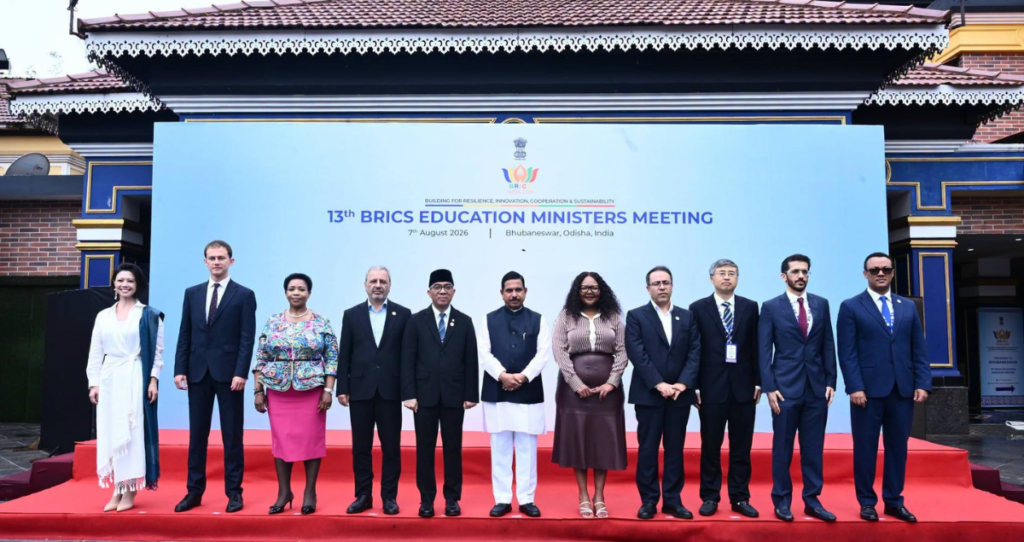
Senior education officials from BRICS member nations gathered in Bhubaneswar for the 3rd BRICS Education Senior Officials’ Meeting, setting the stage for deeper cooperation in education, skills development, research and academic mobility. The meeting was held as part of a three-day engagement that also includes the 13th BRICS Education Ministers’ Meeting, with discussions focused on preparing key outcome documents for the concluding ministerial deliberations scheduled for August 7th.
Held under India’s BRICS chairship theme, “Building for Resilience, Innovation, Cooperation and Sustainability”, the meeting brought together delegates to discuss how member countries can build education systems that are more inclusive, adaptable and prepared for the demands of a rapidly changing world.
The deliberations also reflected the people-centric and humanity-first approach highlighted by Prime Minister Narendra Modi during the 2025 BRICS Summit in Rio de Janeiro. The discussions placed considerable emphasis on institutional partnerships, knowledge exchange and capacity building as important tools for strengthening education across member nations.
Building a Shared Education Roadmap
A major focus of the meeting was the proposed BRICS Education Ministers’ Declaration, which is expected to establish a common roadmap for educational collaboration among member countries.
Senior officials discussed ways to strengthen cooperation while ensuring that education systems remain resilient and responsive to emerging social, economic and technological challenges. Greater institutional collaboration can provide member nations with opportunities to exchange successful practices, develop joint initiatives and strengthen academic networks.
The proposed declaration is expected to bring together several priority areas, including:
- Inclusive and resilient education systems
- Collaborative research and innovation
- Academic leadership and institutional capacity building
- Recognition of qualifications to support academic mobility
- Skills development and workforce preparedness
These areas reflect the changing expectations from education systems, where learning is increasingly connected with employability, innovation and international collaboration.
Traditional Knowledge Enters the Education Conversation
One of the notable areas discussed during the meeting was the proposed BRICS Guiding Principles on Traditional and Indigenous Knowledge Systems.
The initiative seeks to encourage greater recognition of heritage-based knowledge and explore ways of connecting traditional knowledge with contemporary academic frameworks. Such an approach can help education systems preserve cultural knowledge while creating opportunities to study and apply it within modern academic and research environments.
For countries with diverse cultural and intellectual traditions, the inclusion of traditional and indigenous knowledge can broaden the understanding of education beyond conventional classroom learning. It can also encourage cross-cultural knowledge exchange among BRICS nations.
The discussions indicate an effort to create education systems that combine innovation with cultural continuity rather than treating the two as competing priorities.
Strengthening Skills for a Changing Workforce
Skills development emerged as another significant area of discussion during the Bhubaneswar meeting. Officials held bilateral and multilateral exchanges on Technical and Vocational Education and Training (TVET), with member countries sharing experiences and best practices in workforce preparation.
As industries undergo rapid technological and economic changes, education systems are under increasing pressure to ensure that young people develop practical skills alongside academic knowledge. Stronger TVET frameworks can help bridge the gap between education and employment by providing learners with skills relevant to evolving labour markets.
BRICS nations also discussed the possibility of greater alignment between their TVET frameworks. Such cooperation could support knowledge sharing and help countries learn from different approaches to vocational education, training and workforce development.
For young people entering increasingly competitive job markets, stronger links between education, vocational training and industry requirements could prove particularly important.
Early Childhood Education and Research Cooperation
The discussions also extended to Early Childhood Care and Education (ECCE), collaborative research and innovation, academic leadership and the mutual recognition of qualifications.
Early childhood education remains an important foundation for long-term learning and development. By placing ECCE within the broader BRICS education agenda, member nations can share approaches to improving early learning and strengthening support systems for young children.
Research and innovation were another key priority. Greater collaboration between institutions across BRICS countries could encourage joint research projects, academic partnerships and the exchange of expertise. Such initiatives can expand opportunities for scholars and institutions while supporting innovation in areas of shared interest.
The proposed mutual recognition of qualifications is particularly relevant to academic mobility. Greater alignment in the recognition of educational credentials could make it easier for students and academics to pursue learning and professional opportunities across participating countries.
Perspective: Cooperation Beyond Borders
The Bhubaneswar meeting reflects how international education partnerships are increasingly moving beyond traditional academic exchanges. For EducationToday, the discussions are significant because they bring together several issues shaping the future of education: skills, employability, innovation, cultural knowledge, research and student mobility.
The emphasis on cooperation also highlights the importance of preparing learners for a world where educational and professional opportunities increasingly cross national boundaries. Stronger institutional relationships can create avenues for students, teachers, researchers and academic leaders to learn from one another.
At the same time, initiatives such as the proposed guiding principles on traditional and indigenous knowledge demonstrate that international cooperation does not necessarily require countries to move away from their distinct cultural identities.
Click below to watch the video.
Giving Young People a Voice
Youth participation has also been incorporated into India’s BRICS education agenda through the conceptualisation of ‘Model BRICS’, a student-focused initiative organised alongside the ministerial tracks.
The initiative aims to encourage diplomatic and academic engagement among young scholars, allowing students to understand international cooperation and participate in discussions connected with the BRICS framework.
Such initiatives can help young people develop communication, leadership and collaborative skills while exposing them to perspectives from other countries. They also reinforce the idea that students should not merely be recipients of education policy but active participants in shaping the future of international cooperation.
Towards the August 7th Ministerial Meeting
The senior officials’ meeting serves as an important preparatory stage ahead of the concluding BRICS Education Ministers’ Meeting on August 7th. Union Minister for Education Pralhad Joshi is scheduled to participate in the concluding session, where member nations are expected to formally adopt the BRICS Education Ministers’ Declaration.
If adopted, the declaration will provide a shared framework for future educational collaboration among BRICS nations. Its priorities could influence cooperation in areas ranging from early childhood education and research to skills development, academic mobility and traditional knowledge.
The Bhubaneswar meeting therefore represents more than a diplomatic gathering. It reflects a broader effort to build education systems that are resilient enough to respond to change, innovative enough to embrace new opportunities and collaborative enough to learn from one another. As BRICS countries deepen their educational engagement, the focus on skills, knowledge exchange and youth participation could help shape a more connected and future-ready learning ecosystem.
The meeting focused on skills development, innovation, research collaboration and strengthening academic partnerships among BRICS nations.
BRICS includes member countries that collaborate across areas such as education, research, technology, innovation and skill development.
Such collaborations can create opportunities for student exchanges, joint research, knowledge sharing and exposure to global education practices.
The focus on skills aims to prepare learners for future workforce needs by promoting industry-relevant education, technology adoption and innovation.
Academic collaboration helps institutions share expertise, develop joint programmes, encourage research partnerships and improve education quality across countries.