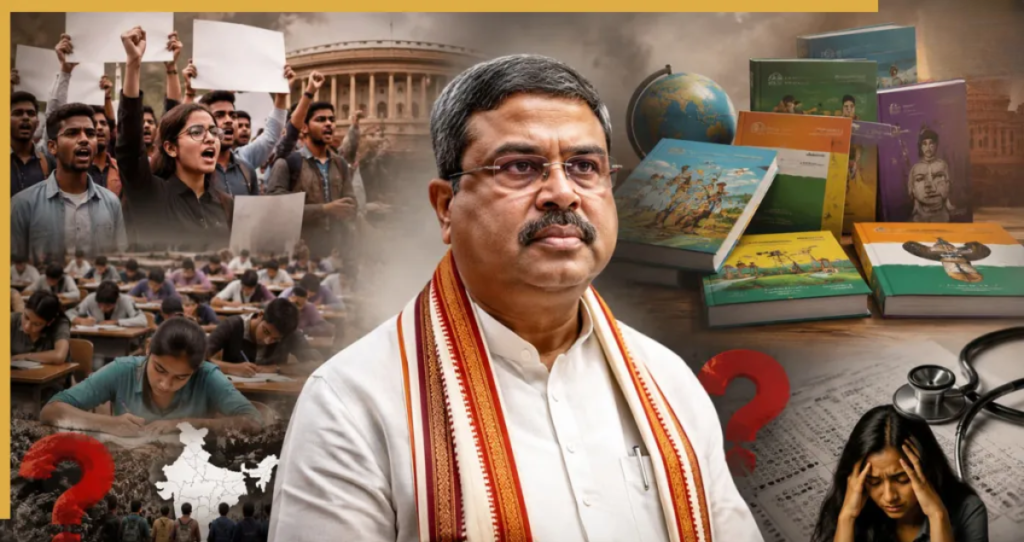
Dharmendra Pradhan’s tenure as India’s Union Education Minister has come to an end following his resignation amid nationwide protests over the NEET-UG controversy. His departure marks the conclusion of more than four years in office, a period characterised by significant policy reforms alongside recurring examination-related controversies. During his leadership, the Ministry of Education introduced several structural initiatives, including the implementation of the National Education Policy (NEP) 2020, while also facing criticism over the handling of national-level examinations and education governance. This combination of ambitious reforms and persistent challenges has left a mixed legacy.
Tenure at a Glance
- Dharmendra Pradhan served as Union Education Minister for more than four years
- His tenure was defined by the implementation of the National Education Policy (NEP) 2020
- The ministry launched the PM SHRI school scheme and promoted digital learning initiatives
- Repeated controversies surrounding NEET, UGC-NET and CBSE examinations drew national attention
- His resignation followed widespread protests linked to the NEET-UG issue
National Education Policy 2020 Takes Centre Stage
One of the defining achievements of Dharmendra Pradhan’s tenure was overseeing the nationwide implementation of the National Education Policy (NEP) 2020. The policy represented one of the most comprehensive reforms in India’s education system in recent decades and aimed to transform school and higher education through structural and curricular changes. The ministry also introduced the PM Schools for Rising India (PM SHRI) scheme, expanded digital learning initiatives and proposed the Viksit Bharat Shiksha Adhisthan Bill, which sought to replace the University Grants Commission (UGC), the All India Council for Technical Education (AICTE) and the National Council for Teacher Education (NCTE) with a unified higher education regulator.
Advocating Multilingual Education
Throughout his tenure, Pradhan remained a strong supporter of multilingual education under the NEP framework. He consistently defended the policy’s three-language approach during debates over its implementation. The language policy, however, became one of the most politically debated aspects of the NEP, particularly during disagreements between the Centre and states such as Tamil Nadu regarding its adoption. The issue remained a significant point of discussion throughout his term.
NEET Controversies Overshadowed Major Reforms
While education reforms formed the foundation of his tenure, repeated controversies surrounding national entrance examinations gradually overshadowed these achievements.
The most significant challenge emerged through the NEET-UG examination. Allegations relating to paper leaks, reported irregularities and the controversy surrounding grace marks led to nationwide protests, legal proceedings and investigations.
The ministry also cancelled the UGC-NET examination shortly after it was conducted following intelligence inputs regarding the alleged circulation of question papers through online platforms. These developments resulted in a Central Bureau of Investigation (CBI) probe, placing examination security at the forefront of national discussion.
National Testing Agency Under Scrutiny
The examination controversies also brought the National Testing Agency (NTA) under sustained public scrutiny.
Responsible for conducting examinations such as NEET, JEE, CUET and UGC-NET, the agency faced criticism over technical glitches, evaluation concerns, cybersecurity issues and its dependence on outsourced systems.
To address these challenges, the Centre constituted expert committees, including one headed by former ISRO chief K. Radhakrishnan, to recommend reforms aimed at improving examination processes. Despite these efforts, concerns over examination management continued during the latter part of Pradhan’s tenure. As EducationTodayNews has consistently observed, maintaining credibility in national examinations remains central to students’ confidence in India’s education system.
CBSE’s On-Screen Marking System Faced Criticism
Another issue that attracted attention during Pradhan’s tenure was the introduction of CBSE’s On-Screen Marking (OSM) system for Class 12th board examinations. Following the digital evaluation process, students and parents reported concerns regarding scan quality, evaluation discrepancies and technical issues. The ministry later acknowledged answer-sheet mix-ups and confirmed that thousands of answer books required manual evaluation due to scanning problems. Administrative changes within the CBSE followed these developments.
Click below to watch the video.
PM SHRI Scheme and State-Level Resistance
The PM SHRI initiative was introduced to strengthen schools aligned with the vision of the National Education Policy.
However, implementation faced resistance from several Opposition-ruled states. Some states delayed or declined to sign the required agreements, arguing that education funding under the Samagra Shiksha programme had been linked to the adoption of the NEP.
Although certain states later joined the initiative, others continued to oppose the policy, highlighting the challenges involved in implementing nationwide education reforms across diverse political environments.
Balancing Reform with Administrative Challenges
Dharmendra Pradhan’s tenure reflected the complexities of leading one of India’s largest ministries during a period of significant educational transformation.
On one hand, the ministry pursued reforms intended to modernise school and higher education through policy changes, digital initiatives and institutional restructuring. On the other, repeated examination controversies raised concerns regarding governance, transparency and operational efficiency.
These parallel developments shaped public perception of the ministry throughout his four-year term, making it one of the most closely scrutinised periods in recent educational administration. TopEducationNews continues to track such developments as they influence policy implementation and the future direction of India’s education sector.
A Mixed Legacy for Indian Education
Dharmendra Pradhan leaves office with a record that combines ambitious policy implementation with persistent administrative challenges. The rollout of the National Education Policy 2020, promotion of multilingual education, expansion of digital learning and launch of the PM SHRI scheme remain notable milestones of his tenure. At the same time, controversies involving NEET, UGC-NET, the National Testing Agency and CBSE evaluations significantly influenced public discourse and shaped perceptions of his leadership. As India’s education system moves forward, many of the reforms initiated during his tenure are expected to continue, while efforts to strengthen examination integrity and institutional accountability are likely to remain key priorities.