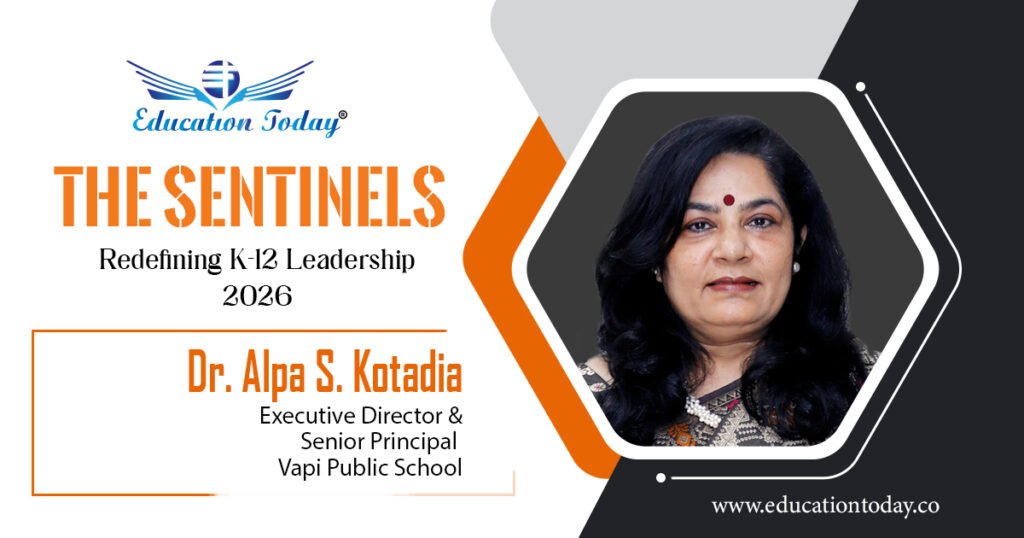
In a time when educational discourse is increasingly shaped by metrics, rankings, and standardized outcomes, Dr. Alpa S. Kotadia offers a more enduring and humanistic perspective. As Executive Director and Senior Principal of Vapi Public School, and a prominent voice across educational and social platforms, she has dedicated over three decades to building institutions that nurture intellect in tandem with integrity. Her work spans curriculum innovation, institutional leadership, child protection advocacy, and holistic wellbeing, yet her philosophy remains strikingly clear: human-centred education is not merely preparation for life; it is life itself in motion.
Through her stewardship, education becomes a lived experience, one that shapes not only what students know, but who they become. In Dr. Kotadia’s world, classrooms are not confined spaces but dynamic environments where curiosity, compassion, and character evolve in tandem, fostering holistic learning and meaningful growth.
From Foundations to Flourishing Institutions: An Educator’s Journey
Dr. Kotadia’s journey into education began in the early 1990s within the modest setting of private coaching classrooms. These formative years proved pivotal, allowing her to observe, at close quarters, the nuances of learner psychology and the importance of joyful, engaging pedagogy, deeply influencing her understanding of child development. It was here that she developed an acute sensitivity to how children think, respond, and internalise knowledge, an insight that would later inform her broader educational philosophy.
A significant chapter in her professional evolution unfolded at Swaminarayan Gurukul in Surat, where she served as an honorary mentor teacher. The institution’s emphasis on discipline, ethical grounding, and value-based living left a lasting imprint on her approach, shaping her perspective on ethical leadership. She came to believe that academic excellence, if divorced from character, remains incomplete.
In 2001, she founded Little Angels Nursery School under the aegis of the Little Angels Education Trust, a modest initiative driven by purpose rather than scale. What began as a small endeavour soon expanded into a larger institutional vision. The establishment of Vapi Public School in 2005 marked a defining milestone, followed by its affiliation with the CISCE in 2012 and subsequent accreditation by NABET. Each of these achievements reflected not merely growth, but a sustained commitment to delivering quality English-medium education to semi-urban and rural communities often underserved by mainstream systems.
Her leadership extended further through her role at Vidyakunj Higher Secondary School, where she fostered collaborative networks and strengthened parent-school partnerships. Even during the unprecedented disruption of the COVID-19 pandemic, her institutions demonstrated resilience, transitioning seamlessly to blended learning models without a single student dropout. For Dr. Kotadia, this continuity was not simply an operational success; it was a reaffirmation of her belief that education must remain inclusive, adaptable, and deeply humane.
Rethinking the Classroom: A Philosophy Rooted in the Learner
Over time, Dr. Kotadia’s philosophy has evolved from a traditional teacher-led approach to a more nuanced, learner-centred ecosystem. Influenced by early exposure to Montessori principles and sociological inquiry, she recognises that each child brings a unique constellation of abilities, emotions and aspirations into the classroom.
This understanding has led to a decisive shift from standardisation to personalisation, from rote memorisation to experiential learning. Intellectual development is no longer pursued in isolation; it is complemented by equal emphasis on emotional and spiritual growth. The integration of IQ, EQ and SQ forms the cornerstone of her educational framework.
Furthermore, by embedding the United Nations Sustainable Development Goals into the curriculum, Dr. Kotadia ensures that learning extends beyond theoretical understanding. Students engage in meaningful activities that nurture global citizenship, translating knowledge into action and responsibility.
Navigating Technology with Purpose and Balance
In an age defined by rapid technological advancement, Dr. Kotadia adopts a balanced and discerning approach. While she acknowledges the importance of digital fluency, she remains cautious of over-reliance on technology at the expense of human connection.
Smart classrooms, artificial intelligence tools and interactive platforms are integrated thoughtfully to enhance accessibility and engagement, reflecting her commitment to educational innovation. However, they are never allowed to supplant the relational core of education.
In this evolving educational landscape, EducationToday continues to provide a platform for recognising and highlighting leadership approaches that place purpose, innovation and human development at the centre of schooling.
Conclusion: Education as an Enduring Legacy
For Dr. Alpa S. Kotadia, education is far more than an institutional endeavour; it is a living legacy, an evolving tapestry woven from intellect, empathy and purpose. Her work stands as a testament to the transformative power of human-centred education, where learning is not confined to classrooms but embedded in lived experience.
Through her visionary leadership, she has created institutions that honour both the mind and the spirit, preparing students not merely to succeed, but to lead with conscience and compassion.
Dr. Alpa S. Kotadia is an educationist and the Executive Director and Senior Principal of Vapi Public School.
She is known for educational leadership, innovative learning approaches, and promoting the holistic development of students.
Her philosophy focuses on nurturing children as unique individuals while developing their intellectual, emotional, spiritual, and ethical dimensions.
She is associated with Vapi Public School and LEAF, an early-learning initiative established under the Little Angels Education Trust.
Her work emphasizes active learning, student development, innovative learning styles, teacher development and continuous improvement in educational practices.