
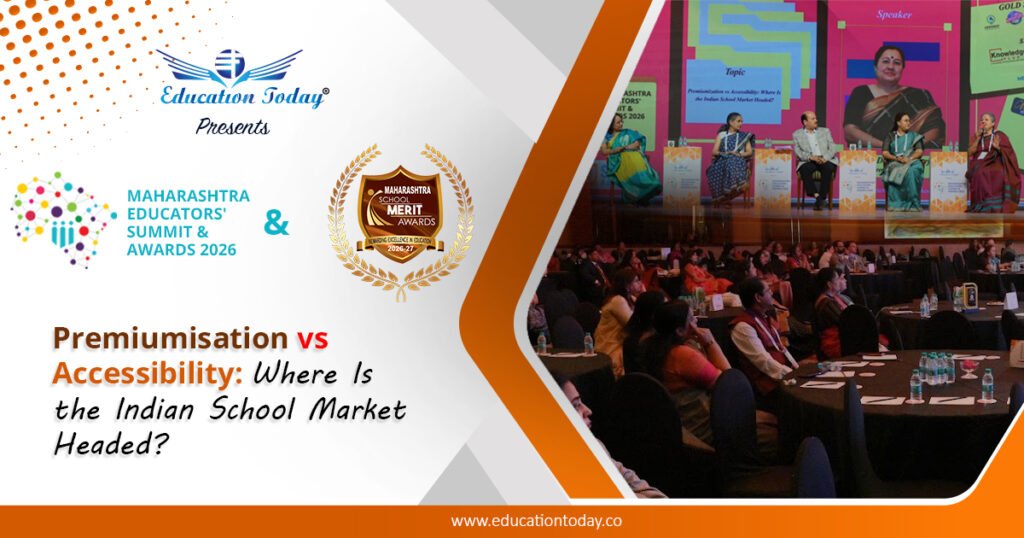
The Maharashtra Educators’ Summit & Maharashtra School Merit Awards 2026, organised by EducationToday, brought together school leaders to examine two pressing questions shaping Indian education: whether schools are equipped to support today’s increasingly anxious students and how the education sector can balance premiumisation with accessibility. Across two panel discussions, educators explored the changing expectations of parents, the importance of emotional well-being, the role of teachers, and the need to make quality education accessible without compromising learning outcomes. The discussions highlighted a shared understanding that the future of education depends on more than academic achievement or impressive infrastructure. Schools must nurture emotionally secure learners, empower teachers, and remain committed to educational values while responding to the changing needs of society.
Panel 2: Premiumisation Versus Accessibility: Where Is the Indian School Market Headed?
The second discussion shifted the focus to the economics and philosophy of school education. Moderated by Dr. Revathi Srinivasan, Director & Dean, Singhania Group of Schools; Principal, Smt Sulochanadevi Singhania School, the panel included Ms. Abha Meghe, CEO, Meghe Group of Schools; Mr. Nikhil Wagh, Founder-Chairman, Educon International School; Dr. Seema Saini, CEO, N. L. Dalmia Educational Society; Principal, N. L. Dalmia High School; and Mrs. Debika Chatterji, Director Principal, JBCN International School Mumbai.
The discussion explored whether premiumisation reflects genuine improvements in educational quality or is increasingly associated with parental aspirations, infrastructure and social status. While families are willing to invest in international exposure, technology-enabled learning and extracurricular opportunities, affordability remains a significant concern.
Ms. Abha Meghe argued that teachers are the backbone of every school and that their salaries, professional capabilities and development cannot be compromised in the pursuit of affordability. Rather than simply reducing expenditure, schools should focus on increasing the educational value delivered for every rupee paid by parents. Better utilisation of infrastructure and appropriate technology can help institutions manage costs without weakening teaching quality.
Mr. Nikhil Wagh similarly maintained that premium education should be defined by student outcomes rather than fees or the exclusivity of admissions. Schools must develop confident individuals, responsible citizens and successful learners. He highlighted the importance of continuous teacher development and technology as a tool that complements classroom teaching, enables personalised learning and supports different learning styles.
Dr. Seema Saini focused on value creation and the responsible use of economies of scale. Larger institutions can benefit from shared infrastructure and better resource utilisation, but expansion must not undermine meaningful teacher-student interaction. A school’s premium positioning should emerge from its educational outcomes, child-centric teaching practices and ability to develop critical thinking, problem-solving and independent learning.
Mrs. Debika Chatterji emphasised the importance of aligning parental expectations with a school’s educational philosophy. She explained that meaningful engagement begins during admissions, when families must understand the institution’s vision, teaching practices and approach to student development.
She also distinguished between equality and equity, explaining that students do not necessarily need identical learning experiences. Instead, schools must distribute available resources according to individual needs. Through teacher training, practical classroom activities and thoughtful lesson planning, institutions can deliver meaningful learning without relying exclusively on expensive infrastructure.
The panellists also discussed how schools could respond to financial pressures without compromising their core responsibilities. Reducing unnecessary expenditure, optimising infrastructure and avoiding excessive spending on facilities or events emerged as possible measures. Teacher salaries, professional development, student safety and educational quality, however, were identified as priorities that must remain protected.
A Shared Vision for the Future of Education
Together, the two discussions at the Maharashtra Educators’ Summit & Maharashtra School Merit Awards 2026 highlighted the interconnected challenges facing Indian schools. Emotional well-being, strong teacher-student relationships, responsible technology adoption, and financial accessibility cannot be treated as separate priorities.
The conversations reinforced the need for schools to communicate clearly with parents, invest in educators, and create environments where every child feels supported. They also challenged the assumption that premium education must necessarily be expensive or defined by infrastructure.
For EducationToday, the discussions offered an important perspective on the direction of school education in India. Ultimately, the measure of a successful institution lies in its ability to deliver meaningful learning, nurture responsible citizens, and prepare children for an uncertain future while remaining inclusive, equitable, and accessible.
Premiumisation refers to the growing demand for schools offering advanced infrastructure, international curricula, specialised programmes, technology-enabled learning, and enhanced facilities, often at higher fees.
Accessibility means ensuring quality education is available to children across different economic backgrounds, geographical locations, and social circumstances.
Parents are increasingly looking for modern infrastructure, global curricula, extracurricular opportunities, personalised learning, and better overall development for their children.
Affordable schools often face challenges related to infrastructure investment, teacher recruitment, operational costs, technology adoption and maintaining educational quality while keeping fees reasonable.
The future will likely depend on balancing premium educational experiences with affordability, inclusivity, academic quality, and wider access to quality schooling.