
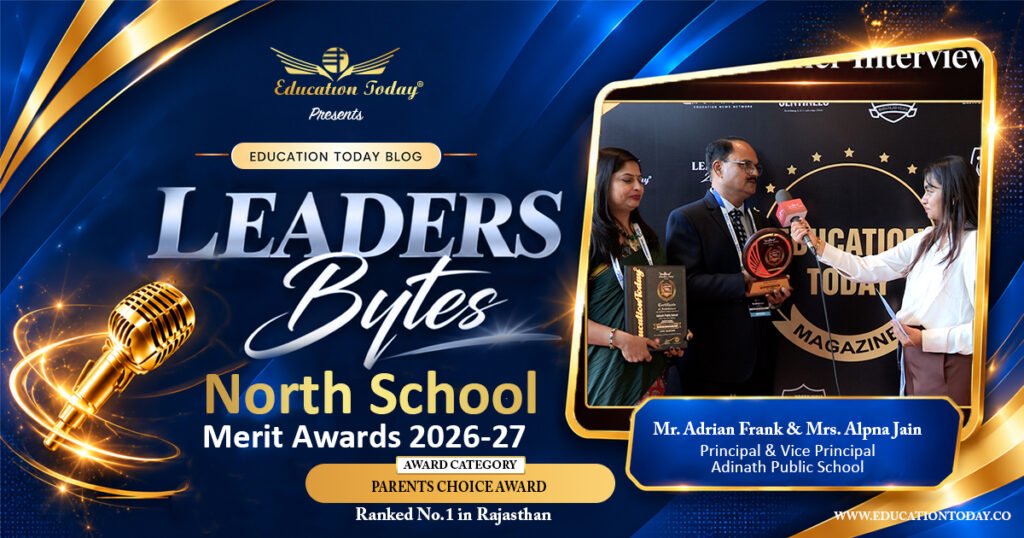
At the North Educators’ Summit & Awards 2026, Mr. Adrian Frank and Mrs. Alpana Jain represent Adinath Public School’s leadership perspective on the evolving role of STEM education in school learning. The interaction highlights the importance of encouraging scientific curiosity, analytical thinking, and problem-solving skills while creating learning opportunities that prepare students for a technology-driven world.
“STEM education is not just about understanding science and technology; it is about inspiring students to question, innovate, and find solutions to real-world challenges.”
This editorially drafted statement reflects the growing significance of STEM education in developing future-ready learners. By connecting scientific concepts with practical applications, schools can encourage students to think critically, experiment with ideas, and approach challenges creatively. Strong school leadership is essential to fostering a learning culture that values exploration, collaboration, and innovation. When STEM learning is supported by meaningful teaching practices and opportunities for inquiry, students can develop the skills and confidence needed to navigate emerging technologies and changing career landscapes. This perspective underscores the importance of combining academic foundations with practical problem-solving to prepare learners for future opportunities.
This feature also offers EducationToday readers a perspective on the ideas and priorities shaping school education.
They emphasise advancing STEM education through collaborative school leadership and a shared commitment to innovation in learning.
STEM education integrates science, technology, engineering, and mathematics to develop practical knowledge and problem-solving abilities.
Collaborative leadership encourages teachers and school leaders to share expertise, coordinate initiatives, and create effective STEM learning opportunities.
STEM learning develops critical thinking, creativity, analytical reasoning, teamwork, and real-world problem-solving skills.
Schools can introduce hands-on experiments, robotics, coding, project-based learning, well-equipped laboratories and interdisciplinary activities.