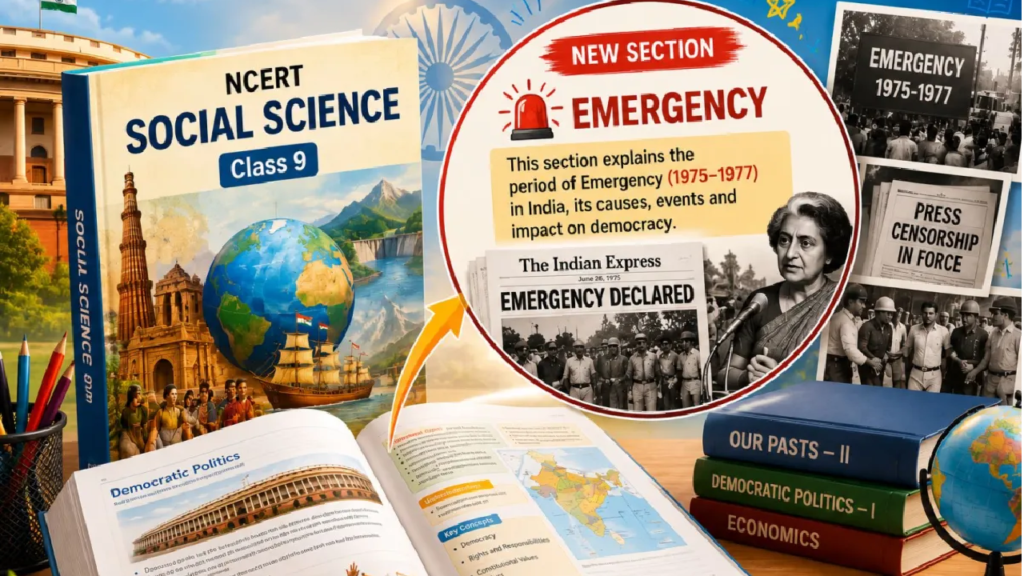
The National Council of Educational Research and Training (NCERT) has introduced a dedicated chapter on the Emergency (1975-77) in the revised Class 9 Social Science textbook, marking the first time the subject has been included at this level. The chapter forms part of the updated curriculum developed under the National Education Policy (NEP) 2020 and aims to provide students with a broader understanding of India’s democratic journey and constitutional values. The newly introduced lesson examines the political developments during the Emergency, the suspension of civil liberties, constitutional changes and the impact of the period on India’s democratic institutions. As reported in EducationTodayNews, the revision is part of NCERT’s ongoing efforts to strengthen historical understanding through a more comprehensive school curriculum.
The inclusion of a chapter dedicated to the Emergency represents a significant change in the Class 9 Social Science syllabus. While students in higher classes have previously studied aspects of this period, the revised curriculum now introduces the topic earlier to help learners build a stronger foundation in modern Indian history.
The chapter seeks to explain one of the most significant political phases in independent India’s history by presenting its constitutional, political and democratic dimensions. Through this addition, students are encouraged to understand the importance of democratic institutions, fundamental rights and the responsibilities of citizens.
The updated textbook will be introduced in schools from the 2026-27 academic session.
According to NCERT, the chapter focuses on several key developments that occurred during the Emergency between 1975 and 1977.
Students will learn about:
- Political developments during the Emergency.
- Suspension of civil liberties.
- Constitutional amendments were introduced during the period.
- The functioning of democratic institutions.
- The significance of constitutional values.
- The importance of protecting democratic principles.
The chapter aims to present these topics within a historical framework that encourages informed learning and critical understanding.
Some of the major highlights of the revised curriculum include:
- NCERT has introduced a dedicated Emergency chapter in Class 9.
- The lesson forms part of the revised curriculum under NEP 2020.
- Students will study constitutional developments and democratic institutions.
- The chapter focuses on the historical events of 1975-77.
- Updated textbooks will be implemented from the 2026-27 academic session.
- The revision aims to strengthen students’ understanding of modern Indian history.
These updates reflect NCERT’s continuing efforts to align school education with evolving curricular objectives.
One of the central objectives of the new chapter is to help students appreciate the significance of constitutional governance and democratic values. By learning about historical events that tested India’s democratic framework, students can better understand the importance of protecting individual rights and institutional accountability.
The chapter also encourages learners to examine how constitutional systems function during periods of political change. Such discussions can strengthen civic awareness while helping students develop analytical and critical thinking skills.
Introducing these concepts at an earlier stage of school education enables students to engage more meaningfully with topics related to governance, citizenship and democracy.
Click below to watch the video.
The curriculum revision aligns with the broader objectives of the National Education Policy 2020, which promotes conceptual understanding, critical thinking and multidisciplinary learning.
Rather than focusing solely on memorising historical facts, the revised Social Science curriculum aims to encourage students to analyse historical developments and understand their relevance in contemporary society.
The inclusion of the Emergency chapter also reflects NCERT’s emphasis on presenting modern Indian history through a wider academic perspective while connecting historical events with constitutional principles and civic responsibilities.
Understanding modern Indian history is essential for helping students appreciate the country’s democratic evolution. Historical events provide valuable lessons about governance, constitutional processes and the importance of safeguarding democratic institutions.
By introducing the Emergency chapter in Class 9, NCERT seeks to provide learners with an opportunity to examine a significant period in India’s post-independence history through an educational lens.
Teachers can also use the chapter to encourage classroom discussions on citizenship, rights, responsibilities and the functioning of democratic systems, making history more relevant and engaging for students.
The revised Social Science textbook is expected to become an important resource for schools implementing the updated curriculum from the 2026-27 academic year.
The inclusion of the Emergency chapter may also encourage educators to adopt discussion-based teaching methods that help students analyse historical developments rather than simply memorising events.
For students, the revision offers greater exposure to constitutional history and democratic values, supporting the development of informed and responsible citizens.
The introduction of a dedicated chapter on the Emergency in the Class 9 Social Science textbook marks a notable development in India’s school curriculum. By incorporating this important period of modern Indian history, NCERT aims to strengthen students’ understanding of democracy, constitutional governance and civic responsibility from an early stage. The revised curriculum under NEP 2020 reflects a continued focus on providing balanced historical learning while encouraging critical thinking and constitutional awareness. The new chapter is expected to play an important role in helping students understand the historical events that have shaped India’s democratic institutions and continue to influence the nation’s constitutional journey.