
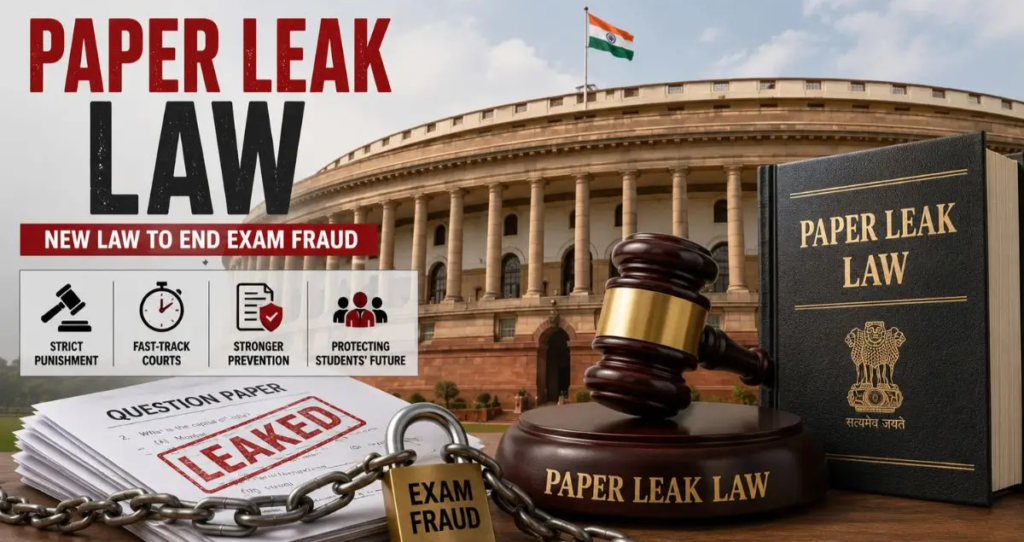
The integrity of public examinations has become one of the most pressing concerns in India’s education landscape. Repeated incidents of examination paper leaks over the past few years have raised serious questions about the credibility of recruitment and admission processes, affecting millions of students and job aspirants. In response to these growing concerns, Parliament has passed the Public Examinations (Prevention of Unfair Means) Amendment Bill, 2026, introducing tougher legal measures to combat organised examination fraud. The Bill was cleared by the Rajya Sabha through a voice vote following a heated debate, while Opposition parties staged a walkout during the proceedings. As the education sector closely watches this development, TopEducationNews examines what the new legislation means for students, examination authorities and the future of fair assessments across the country.
Why the Amendment Was Introduced
India conducts numerous public examinations each year for admissions to higher education institutions and recruitment into government services. However, recurring cases of question paper leaks and organised cheating have undermined public confidence in these examinations. The amendment seeks to strengthen the legal framework introduced earlier by imposing stricter punishments on those involved in organised examination fraud. The government has argued that stronger deterrence is necessary to safeguard the interests of honest candidates and restore trust in public examinations.
Key Highlights of the New Law
The amended legislation introduces several significant provisions aimed at preventing examination malpractice.
Some of the major changes include:
- Imprisonment of up to 10 years for individuals involved in organised paper leak networks
- Financial penalties that can extend up to ₹10 crore for serious offences
- Time-bound investigations into examination-related offences
- Establishment of a Special Task Force to coordinate investigations
- Fast-track courts for quicker disposal of cases related to examination fraud
These measures are intended to ensure that organised criminal networks involved in examination malpractices face swift and stringent action.
Parliamentary Debate and Opposition Walkout
The Bill witnessed an intense debate in the Rajya Sabha before receiving parliamentary approval. Government representatives maintained that stronger legal safeguards were essential to protect the future of students and maintain the credibility of public examinations.
Opposition members, however, questioned the government’s handling of previous examination controversies and demanded greater accountability. The debate eventually culminated in an Opposition walkout before the Bill was passed by a voice vote. Despite the political differences, the legislation completed the parliamentary process.
Government’s Stand on Examination Integrity
Following the passage of the Bill, Prime Minister Narendra Modi described the legislation as an important step towards creating a more credible and trustworthy examination system. He stated that the amendment would strengthen efforts to eliminate organised paper leak networks and ensure that the future of students is protected from unfair practices.
The government has consistently maintained that examination reforms require not only technological improvements but also stronger legal enforcement against criminal syndicates that manipulate recruitment and admission processes.
It is this broader commitment to educational integrity that continues to shape policy discussions across the country, a development closely followed by EducationToday as schools, universities and examination authorities adapt to evolving regulatory standards.
Why This Matters for Students
For millions of candidates preparing for competitive examinations, the credibility of the examination process is as important as academic preparation itself.
Paper leaks often result in cancelled examinations, delayed recruitment processes and emotional distress for candidates who have invested months or even years preparing for a single opportunity. By introducing stricter punishments and faster investigations, the government hopes to reduce such disruptions and improve public confidence in examination systems.
The legislation also sends a strong message that organised examination fraud will attract severe legal consequences.
Click below to watch the video.
Strengthening Institutional Accountability
The amendment places greater emphasis on institutional responsibility in preventing examination-related offences. Investigative agencies, examination authorities and law enforcement bodies are expected to work more closely through coordinated mechanisms established under the amended law. The introduction of dedicated investigative structures and fast-track judicial processes could significantly reduce delays that have often characterised previous examination fraud cases. Faster investigations may also discourage organised groups from attempting similar offences in future recruitment and admission examinations.
A Step Towards Restoring Public Trust
Public examinations remain one of the most important gateways to educational and professional opportunities in India. Their credibility directly influences public confidence in higher education admissions and government recruitment.
While legislation alone cannot eliminate every instance of malpractice, stronger enforcement mechanisms create a more robust deterrent against organised cheating networks. Combined with secure examination technologies, improved administrative practices and transparent monitoring systems, the amendment could contribute towards building a more reliable examination ecosystem.
Successful implementation will depend on effective coordination between investigative agencies, examination authorities and the judiciary.
Looking Beyond Legislation
The passage of the Public Examinations (Prevention of Unfair Means) Amendment Bill, 2026 marks another significant milestone in India’s ongoing efforts to safeguard the integrity of public examinations. With enhanced penalties, faster investigations and specialised enforcement mechanisms, the legislation aims to ensure that merit remains the defining factor in competitive examinations rather than organised malpractice. For students, educators and recruitment agencies alike, the effectiveness of the law will ultimately be measured by its implementation. If enforced consistently, it has the potential to restore confidence in examination systems and reinforce the principle that every deserving candidate should compete on a level playing field.
It is legislation aimed at preventing cheating, paper leaks and organised malpractice in public examinations and recruitment processes.
The legislation seeks to strengthen examination security and deter organised cheating and unfair practices affecting candidates.
It targets organised forms of malpractice, including leaking exam papers, unauthorised assistance and other offences connected with public examinations.
The provisions primarily apply to organisations and individuals involved in conducting or facilitating specified public examinations and related malpractice.
Stricter penalties and accountability are intended to discourage paper leaks, improve examination integrity and provide a fairer environment for candidates.