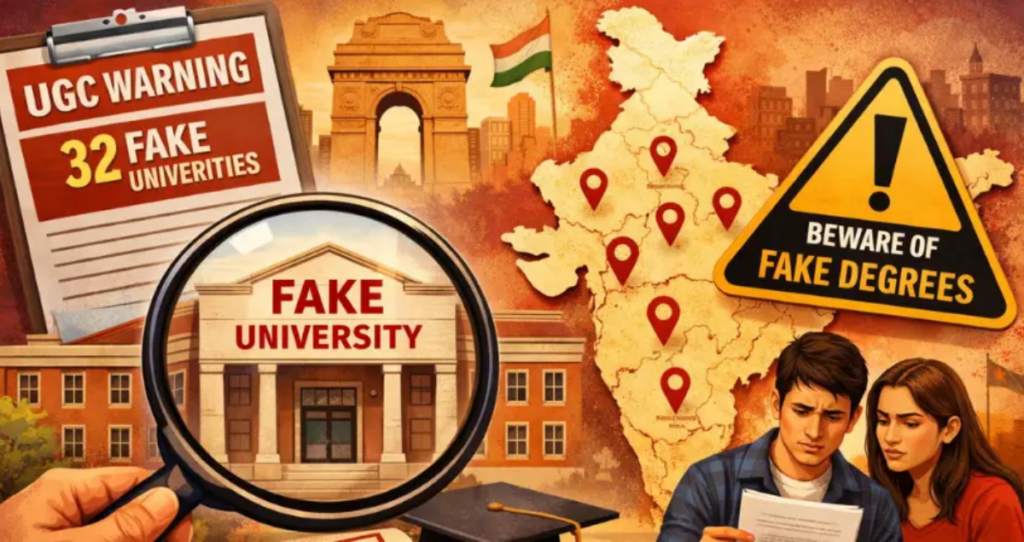
India’s higher education landscape has received another important regulatory warning, with the University Grants Commission (UGC) flagging 32 institutions operating as unauthorised universities across the country. The latest alert comes at a crucial time for students and families making decisions about admissions, courses and career pathways. The regulator has also cautioned students against misleading claims made through unauthorised collaborations between educational institutions and EdTech platforms.
The development, featured among the latest TopEducationNews, highlights a growing concern in higher education: students can sometimes be drawn towards institutions or programmes based on attractive advertisements, placement promises and online promotions without first checking whether the qualification is legally recognised.
The UGC has made it clear that institutions appearing on its list of fake universities are not authorised to award recognised degrees. Students therefore need to exercise greater caution before paying fees or enrolling in programmes promoted through unfamiliar institutions or third-party platforms.
32 Institutions Under the UGC Scanner
According to the latest information, 32 institutions across 12 states and Union Territories have been identified as unauthorised. Delhi accounts for the largest share, with 12 institutions on the list.
The UGC maintains a dedicated list of institutions that are not legally empowered to confer degrees. The regulator’s position is particularly important because the name or presentation of an institution alone does not establish its legal status. Under the regulatory framework, universities must meet specific statutory requirements before they can award recognised degrees.
The institutions identified in the latest list are spread across several parts of the country, making the warning relevant to students regardless of their location or preferred mode of study.
Why Unauthorised Universities Are a Serious Concern
For a student, choosing a university is much more than selecting a campus or course. A degree can influence eligibility for employment, further education, professional opportunities and competitive examinations. If the institution awarding that qualification is not legally authorised, the student may eventually discover that the degree does not carry the recognition expected.
The UGC has specifically warned that qualifications issued by institutions that are not authorised to award degrees cannot be treated as valid for formal purposes. This can create significant difficulties for students who have already invested considerable time and money in their education.
The warning also underlines an important point: attractive course names, professional-looking websites and placement claims should not be treated as proof of recognition.
EdTech Tie-Ups Under Greater Scrutiny
The UGC’s warning extends beyond institutions calling themselves universities. It has also raised concerns about unauthorised collaborations involving EdTech platforms.
Digital learning has expanded rapidly, giving students access to programmes from institutions across geographical boundaries. However, this convenience also means that students must distinguish between a legitimate academic partnership and an arrangement that does not have the necessary regulatory approval.
Some promotional campaigns may highlight guaranteed placements, high-paying jobs or quick access to degrees and diplomas. Such claims can be particularly appealing to students looking for affordable or flexible higher education options.
The UGC has therefore urged students to verify the legitimacy of both the institution and the programme before making a commitment. It has also cautioned against unauthorised franchise arrangements and stressed the importance of regulatory compliance.
What Students Should Check Before Admission
The latest warning is a reminder that admission decisions should be based on verified information rather than promotional material alone. Students and parents can take a few basic precautions:
- Check whether the university appears on the UGC’s recognised university information or official regulatory lists
- Verify whether the institution is legally authorised to award the specific qualification being advertised
- Be cautious about programmes promoted through third-party platforms or franchise arrangements
- Do not rely solely on claims about guaranteed placements, salaries or career outcomes
- Confirm recognition before paying fees or submitting admission documents
These checks may take only a few minutes but can prevent years of difficulty later.
Click below to watch the video.
A Reminder for Students and Parents
The UGC’s latest action comes at a time when higher education choices are becoming increasingly diverse. Students can now access traditional universities, online programmes, distance education, international collaborations and technology-enabled learning opportunities. While this expansion has created more choices, it has also made verification more important.
The regulator has urged students to remain vigilant and has indicated that appropriate action can be taken against institutions operating outside the prescribed framework. Its Anti-Malpractice Cell also plays a role in monitoring violations and addressing concerns relating to higher education practices.
For parents, the message is equally significant. Admission decisions should involve checking official sources rather than relying entirely on agents, advertisements, social media posts or institutional claims.
Making Verification Part of the Admission Process
The latest UGC alert is ultimately about protecting students from the long-term consequences of an uninformed admission decision. A university’s recognition status should be considered as important as its course structure, location, fees or placement record.
As students prepare for their next academic step, EducationToday encourages learners and families to treat verification as an essential part of the admission process. Checking official regulatory information before enrolling can help students avoid invalid degrees and the financial and academic uncertainty that may follow.
The UGC’s list of fake universities serves as a timely reminder that in higher education, a promising opportunity is worth pursuing only when its credentials stand on a legitimate regulatory foundation.
UGC has identified 32 fake universities operating across different states and union territories of India and warned students against enrolling in them.
UGC has cautioned students because institutions not recognised by the regulator are not authorised to award valid degrees under the law.
Students can verify the recognition status of universities through the official UGC website and approved institution lists before taking admission.
UGC has advised students to be careful about unauthorised collaborations between recognised universities and EdTech platforms that offer unapproved degree or diploma programmes.
Students should verify university recognition, course approval status, accreditation details and admission guidelines before paying fees or submitting applications.