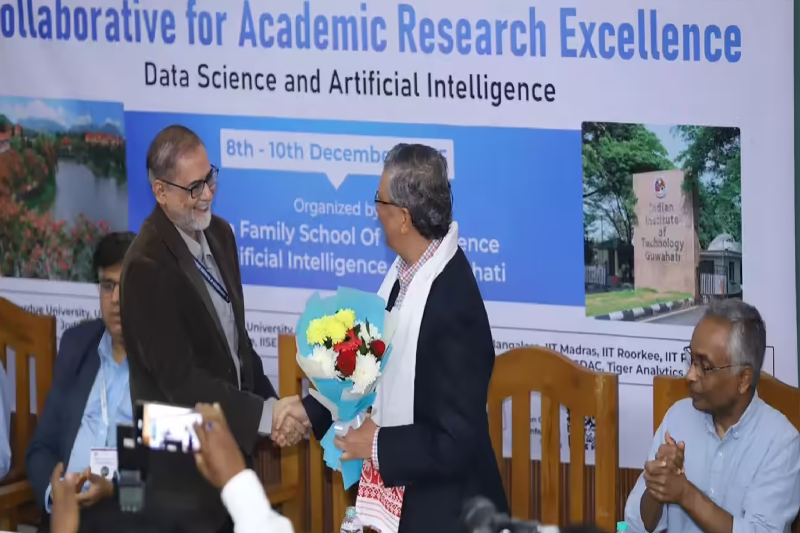
IIT Guwahati Hosts Inaugural CARE Conference on Data Science and AI to Shape Responsible AI in India
IIT Guwahati recently hosted its first Collaborative for Academic Research Excellence (CARE) Conference on Data Science and AI, bringing together leading global universities, Indian institutions, and industry experts to discuss responsible AI development. Held from December 8 to 10, 2025, the event aimed to contribute to an upcoming AI Vision Document, outlining a framework for inclusive, responsible, and future-ready AI in India.
The conference is planned as an annual platform to strengthen collaborative research networks and advance India’s leadership in AI, leveraging both national and international expertise.
Global and National Collaboration
The CARE Conference brought together top-tier institutions, including:
- Global universities: MIT, Purdue University, UC San Diego, Penn State, UT Dallas
- Indian institutions: IITs, IISERs, NITs
Hosted by the Mehta Family School of Data Science and Artificial Intelligence at IIT Guwahati, the conference showcased India’s growing ambition in AI research. Rahul Mehta, Founder of the Mehta Family Foundation, highlighted the event’s role in advancing a blueprint for national AI leadership, while Prof. Ratnajit Bhattacharjee, Head of the School, emphasized India’s expanding research capacity in foundational algorithms, generative architectures, and AI for societal impact.
Conference Structure and Activities
Supported by the Bhupat and Jyoti Mehta Family Foundation, the three-day conference featured a mix of academic and industry-focused sessions:
- Technical talks exploring cutting-edge AI research
- Panel discussions on societal and scientific implications
- Industry sessions highlighting real-world AI applications
- Poster presentations and flash talks showcasing emerging work
Participants discussed next-generation AI models, including generative modeling, explainability, hallucination-resistant architectures, and sharpness-aware learning. The event encouraged knowledge exchange between global experts and Indian researchers, enhancing transparency and reliability in modern AI systems.
Focus on Healthcare and Biomedicine
Healthcare emerged as a key theme, with sessions covering:
- AI-driven diagnostics and biomedical modeling
- Radiology workflow automation
- Expert-guided clinical decision systems
A dedicated panel on AI for biomedical applications highlighted research opportunities and gaps India needs to address to build a robust health-tech ecosystem. These discussions emphasized the potential for AI to revolutionize patient care, improve diagnostics, and support clinical decision-making.
Engineering, Robotics, and Infrastructure Applications
The conference also explored AI applications in engineering and infrastructure, with contributions from:
- Purdue University
- IISER Thiruvananthapuram
- IIT Indore
Key topics included:
- Behaviourally intelligent robots
- AI-assisted quantum algorithms
- Seismic modeling for infrastructure planning
- Cybersecurity and threat detection
These sessions demonstrated the convergence of data science, high-performance computing, and engineering research, highlighting India’s potential to strengthen its technical capabilities and global competitiveness.
Machine Learning in Advanced Research Areas
Experts also discussed machine learning applications in complex scientific and technical fields, including:
- Cryptanalysis and cybersecurity
- Data assimilation in dynamic systems
- Modeling complex physical phenomena
Presentations from DRDO and academic researchers showed how mathematical tools and AI-driven models can enhance cryptographic resilience and improve simulation accuracy, paving the way for secure, efficient, and advanced scientific research in India.
Towards a Responsible AI Vision
The CARE Conference emphasized the importance of responsible and inclusive AI development. Insights from discussions and presentations will contribute to India’s upcoming AI Vision Document, which aims to:
- Establish frameworks for ethical AI use
- Promote inclusive access and benefits of AI technologies
- Support future-ready AI research and deployment in various sectors
By combining academic rigor, industry perspectives, and policy considerations, the conference positioned India to lead responsibly in AI innovation.
Conclusion
IIT Guwahati’s first CARE Conference marks a milestone in India’s AI ecosystem, highlighting the country’s potential to be a global leader in responsible AI. By fostering collaboration between international universities, Indian institutions, and industry, the event set the stage for cutting-edge research, ethical deployment, and practical applications of AI across healthcare, engineering, robotics, cybersecurity, and beyond.
As India moves forward with its AI Vision Document, conferences like CARE will play a critical role in shaping future-ready, ethical, and impactful AI systems for the nation.