NBEMS Issues Crucial Notice on Barcode Errors for DNB 2025 Candidates: What You Must Know to Avoid Result Cancellation
The National Board of Examinations in Medical Sciences (NBEMS) has begun the DNB Final Theory Examinations, December 2025, scheduled from December 18 to December 21 across examination centres nationwide. For thousands of postgraduate medical candidates, this exam represents the final step toward Diplomate of National Board (DNB) certification—a milestone earned after years of intensive training and preparation.
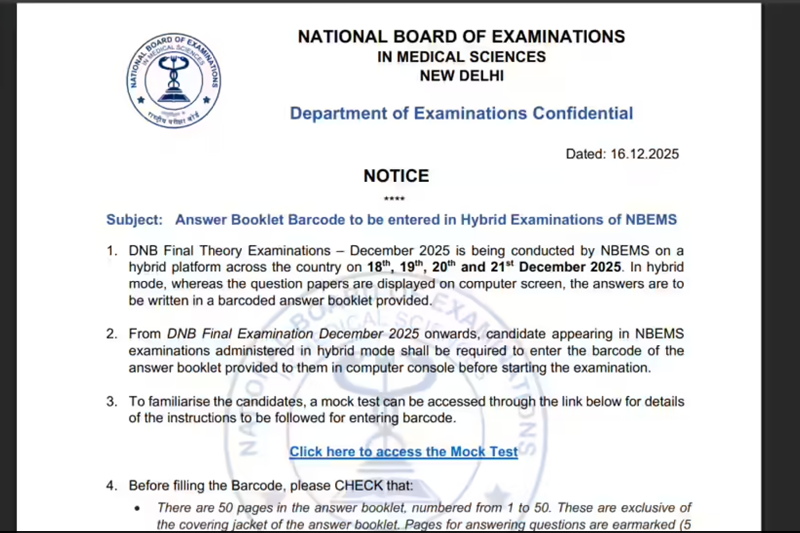
However, alongside the launch of the examinations, NBEMS has issued a critical notice that every DNB 2025 candidate must take seriously. The board has made it explicitly clear that any error related to barcode entry will result in automatic rejection and cancellation of the candidate’s result, regardless of academic performance.
With the exams being conducted in hybrid mode, technical accuracy has become just as important as subject knowledge. This blog explains the notice in detail, the hybrid exam format, compliance requirements, and why the margin for error is officially zero.
DNB Final Theory Exam 2025: Key Dates and Format
The DNB Final Theory Examinations (December 2025) are being conducted from December 18 to December 21 at designated centres across India. Unlike traditional exams, NBEMS is using a hybrid examination model, which blends digital and physical components.
Under this system:
- Questions are displayed on a computer screen
- Answers must be written in a physical, barcoded answer booklet
This format is designed to improve efficiency and security, but it also introduces additional layers of technical responsibility for candidates. NBEMS has clearly indicated that failure to follow these procedures precisely will have serious consequences.
Barcode Errors: NBEMS Issues a Zero-Tolerance Warning
The most important takeaway from the NBEMS notice is its strict stance on barcode-related errors.
Each candidate is provided with a unique barcoded answer booklet. Before starting the exam, candidates must correctly enter the barcode number from their answer booklet into the system. This step links the candidate’s identity, exam session, and written answers.
NBEMS has warned that:
- Any mistake in barcode entry is fatal
- Once the barcode is submitted, the answer booklet cannot be replaced
- No appeals, representations, or correction requests will be entertained
- Errors will lead to automatic rejection and cancellation of the result
In short, even a minor mistake—such as entering the wrong barcode or failing to verify the booklet—can nullify months or years of preparation.
Hybrid Mode Rules: Absolute Precision Is Mandatory
In the hybrid examination setup, candidates must constantly align what appears on the screen with what they write in the answer booklet. This system leaves no room for assumptions or shortcuts.
NBEMS has clarified that:
- The barcode entry step is mandatory before the exam begins
- Accuracy in barcode submission is non-negotiable
- Responsibility for correct submission lies entirely with the candidate
The board has adopted a zero-tolerance approach toward technical non-compliance, treating barcode errors as procedural violations rather than clerical mistakes.
Mock Test Facility: A Crucial Safeguard for Candidates
To reduce the risk of avoidable errors, NBEMS has provided an online mock test for DNB candidates. This mock test is not merely a practice paper—it is specifically designed to familiarise candidates with:
- Barcode entry procedures
- Navigation of the hybrid exam interface
- Exam-day protocols and workflow
NBEMS has strongly urged all candidates to attempt the mock test. Skipping it could increase the chances of confusion or errors during the actual exam, particularly under pressure.
Candidates are advised to treat the mock test as a mandatory rehearsal, not an optional resource.
Candidate Guidelines: Mandatory Checks Before Barcode Submission
Before entering and submitting the barcode, NBEMS has instructed candidates to thoroughly verify their answer booklet. The board has laid down specific compliance checks, all of which must be followed without exception.
Candidates must ensure that:
- The answer booklet contains exactly 50 numbered pages, excluding the cover
- All pages carry the same barcode, with no mismatches
- The booklet is fully intact, with:
- No torn pages
- No damaged sheets
- No blank pages
- No misprinted or defective pages
If even one of these conditions is not met, candidates must immediately alert the invigilator before barcode submission. Once the barcode is submitted, the booklet is locked into the system and cannot be replaced.
NBEMS has reiterated that any deviation will render the answer booklet invalid for evaluation.
No Liability Clause: Responsibility Lies with the Candidate
In its notice, NBEMS has explicitly stated that it disclaims all liability for errors arising from candidate negligence. This includes:
- Incorrect barcode entry
- Failure to verify booklet details
- Ignoring mock test instructions
- Overlooking damaged or mismatched pages
The board has made it clear that procedural lapses will not be treated leniently, regardless of intent or circumstance. Candidates are expected to exercise due diligence at every step.
Stakes at Their Highest: One Error Can End It All
The DNB Final Theory Examination is not just another test—it is the final academic hurdle in the DNB certification journey. For many candidates, it marks the transition from training to independent professional practice.
With NBEMS enforcing strict procedural compliance, success now depends on:
- Strong academic preparation
- Calm execution on exam day
- Absolute adherence to technical instructions
As the board’s notice makes unmistakably clear, a single mistake in barcode submission can erase years of effort in seconds.
Final Word for DNB 2025 Candidates
As the December 2025 examinations get underway, DNB candidates must remember that attention to detail is no longer optional. The hybrid exam format demands vigilance, patience, and procedural accuracy.
Before starting the exam:
- Verify your answer booklet thoroughly
- Double-check the barcode
- Use the mock test to eliminate uncertainty