TS DOST 2026 Registration Begins: UG Admissions Guide
Navigating TS DOST 2026: A Comprehensive Guide to Telangana’s Streamlined Undergraduate Admissions
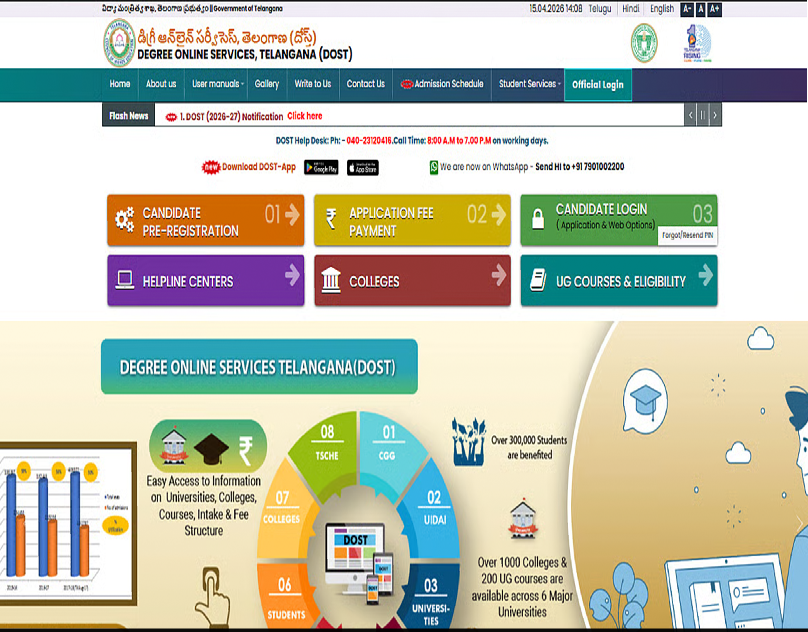
In an increasingly digitised educational landscape, the need for simplified, transparent and accessible admission systems has never been more pronounced. The launch of the TS DOST 2026 registration window marks yet another step in this direction, reaffirming Telangana’s commitment to modernising higher education access. Designed as a unified platform for undergraduate admissions, Degree Online Services, Telangana (DOST) continues to reshape how students transition from school to university. With the registration process commencing on April 15, 2026, the Telangana Council of Higher Education (TGCHE) has formally initiated admissions for the 2026–27 academic session. This centralised system enables students to apply for a wide array of undergraduate programmes, including BA, BCom, BSc, BBA and BCA, through a single digital interface, eliminating the need for multiple applications across institutions.
A Unified Admission Ecosystem
At its core, TS DOST represents a paradigm shift from fragmented admission processes to a cohesive, student-friendly system. Traditionally, aspiring undergraduates were required to navigate a labyrinth of college-specific forms, deadlines and criteria. DOST simplifies this experience by offering a single-window mechanism that integrates application, course selection, and seat allotment.
The platform is not merely a logistical tool; it embodies a philosophy of inclusivity and efficiency. By centralising admissions across numerous universities and affiliated colleges in Telangana, it ensures that students from diverse socio-economic backgrounds can access higher education opportunities without procedural complexity.
Moreover, the digital nature of the system aligns seamlessly with broader national initiatives aimed at promoting e-governance and digital literacy. Students can complete the entire process, from registration to seat confirmation, online, thereby reducing administrative burdens and enhancing accessibility.
Understanding the Admission Timeline
The TS DOST 2026 admission process unfolds in multiple phases, each designed to accommodate varying student preferences and timelines. Phase 1 registration, which opened on April 15, is expected to continue until early May, followed by subsequent phases that extend the opportunity for admission.
This phased approach serves a dual purpose. Firstly, it allows students to reconsider and refine their choices based on seat availability and personal preferences. Secondly, it ensures optimal utilisation of available seats across institutions, minimising vacancies and enhancing efficiency.
Following registration, candidates proceed to the web options stage, where they can select preferred courses and colleges. The system then employs a merit-based algorithm to allocate seats, ensuring fairness and transparency. Seat allotment results are published online, and students can confirm their admission through a streamlined self-reporting process.
Eligibility and Application Process
The eligibility criteria for TS DOST 2026 are straightforward, reflecting the platform’s emphasis on accessibility. Students who have completed their Intermediate or equivalent examinations are eligible to apply. The application process begins with the creation of a DOST ID, followed by the submission of personal and academic details, and payment of the requisite fee.
Candidates are advised to ensure that their contact information, particularly email address and mobile number, is accurate and active, as these serve as primary channels for communication throughout the admission process. Supporting documents, including academic certificates and identification proof, must also be uploaded during registration.
What distinguishes DOST from conventional systems is its intuitive design. The platform guides applicants through each step, reducing the likelihood of errors and ensuring a smooth user experience. For many students, particularly those navigating digital systems for the first time, this simplicity is invaluable.
Enhancing Transparency and Fairness
One of the most significant advantages of TS DOST is its commitment to transparency. The merit-based seat allotment system eliminates subjectivity, ensuring that admissions are conducted fairly and efficiently. By automating key processes, the platform reduces the scope for discrepancies and enhances accountability.
Additionally, the availability of real-time updates allows students to track their application status, seat allotment results, and subsequent steps. This level of visibility not only reduces anxiety but also empowers students to make informed decisions.
The system also incorporates provisions for multiple rounds of counselling, enabling students to upgrade their allotted seats if better options become available. This flexibility is particularly beneficial in a competitive academic environment, where preferences may evolve.
A Wide Spectrum of Academic Opportunities
TS DOST 2026 offers access to a diverse range of undergraduate programmes across disciplines. From traditional courses in arts and sciences to professional programmes in business administration and computer applications, the platform caters to varied academic interests and career aspirations.
Participating institutions include a vast network of universities and colleges across Telangana, collectively offering hundreds of courses. This extensive coverage ensures that students have ample choice, enabling them to align their academic pursuits with their long-term goals.
Furthermore, the system supports nearly 200 undergraduate courses across numerous colleges, reflecting the breadth and depth of educational opportunities available through DOST.
The Role of Technology in Modern Admissions
The success of TS DOST underscores the transformative potential of technology in education. By leveraging digital tools, the platform has streamlined complex processes, making them more accessible and efficient. This aligns with broader trends in higher education, where technology is increasingly being used to enhance both administrative efficiency and student experience.
Features such as online registration, digital document submission, and automated seat allotment exemplify how technology can simplify traditionally cumbersome processes. Moreover, the platform’s scalability ensures that it can accommodate large volumes of applicants without compromising performance.
In many ways, TS DOST serves as a model for other states seeking to modernise their admission systems. Its emphasis on user-centric design, transparency and efficiency offers valuable insights into the future of higher education administration.
Challenges and Considerations
While TS DOST represents a significant advancement, it is not without its challenges. Digital platforms, by their very nature, require reliable internet access and a certain level of technological proficiency. For students in remote or underserved areas, these requirements can pose barriers.
To address this, the Telangana government has established helpline centres and support systems to assist applicants. These centres guide registration, document submission and other aspects of the admission process, ensuring that no student is disadvantaged due to technological constraints.
Another consideration is the need for awareness. Despite the platform’s benefits, its effectiveness depends on students being informed about its features, timelines and requirements. Continuous outreach and communication are therefore essential to maximise participation and ensure equitable access.
Looking Ahead
As TS DOST 2026 progresses through its various phases, it is poised to facilitate the admission of thousands of students into undergraduate programmes across Telangana. Beyond its immediate impact, however, the platform represents a broader shift towards digital governance in education. By prioritising efficiency, transparency and inclusivity, TS DOST exemplifies how technology can be harnessed to address systemic challenges in higher education. Its continued evolution will likely incorporate additional features and enhancements, further refining the admission experience.
Conclusion
The opening of the TS DOST 2026 registration window marks a pivotal moment in Telangana’s higher education landscape. More than just an administrative milestone, it reflects a commitment to creating a system that is accessible, transparent and aligned with the needs of modern learners. For students, the platform offers a streamlined pathway to higher education, reducing complexity and empowering informed decision-making. For institutions, it ensures efficient seat allocation and improved resource utilisation. And for the broader education ecosystem, it sets a benchmark for innovation and inclusivity. As the admission season unfolds, TS DOST stands as a testament to the transformative power of digital solutions in education: bridging gaps, simplifying processes and ultimately enabling students to embark on their academic journeys with confidence and clarity.