VP C. P. Radhakrishnan on AI in Governance: Inclusive Future Vision
Reimagining Governance in the Age of AI: Vice President Radhakrishnan’s Vision for an Inclusive Future
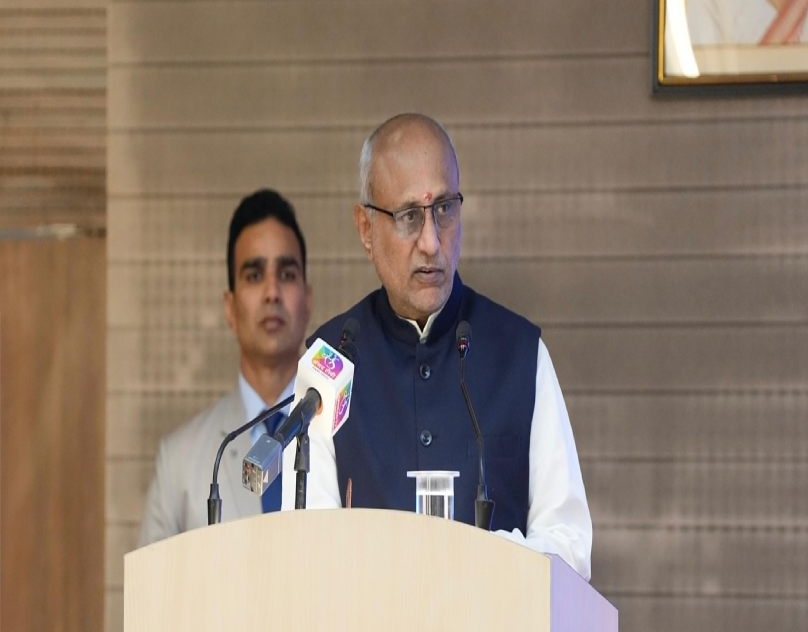
In an era increasingly defined by rapid technological advancement, the role of Artificial Intelligence (AI) in governance has moved from speculative discourse to practical necessity. Addressing this evolving paradigm, Vice President C. P. Radhakrishnan delivered a compelling address at the 5th Dr. Rajendra Prasad Memorial Lecture, held at the Indian Institute of Public Administration during its 72nd Founders’ Day celebrations. His remarks offered both a visionary outlook and a pragmatic roadmap for integrating AI into India's machinery of governance.
At the heart of his address was a powerful assertion: Artificial Intelligence is not merely a technological advancement, but a transformative force capable of reshaping governance into a more inclusive, efficient and citizen-centric system. By framing AI as a “human revolution,” the Vice President underscored its profound societal implications, positioning it as a catalyst for redefining the relationship between the state and its citizens.
AI as the Cornerstone of Future Governance
The Vice President articulated a clear vision of governance augmented by intelligent systems, one that is faster, smarter and more transparent. He emphasised that AI enables governments to better understand citizens' nuanced needs through data-driven insights, thereby facilitating more responsive and effective public service delivery.
In practical terms, this translates into a governance model where policies are no longer static instruments but dynamic frameworks informed by real-time data. AI-driven analytics allow for targeted interventions, ensuring that benefits reach intended recipients with minimal leakage. This capability is particularly significant in a country as vast and diverse as India, where equitable distribution of resources remains a persistent challenge.
Moreover, the Vice President highlighted that governance must ultimately be about service rather than authority, a principle exemplified by Dr. Rajendra Prasad, in whose honour the lecture was instituted. Drawing from his legacy of integrity and moral courage, the Vice President reinforced the idea that technological progress must be guided by ethical responsibility and a commitment to public welfare.
Bridging Policy and People Through AI
One of the most compelling themes of the address was the role of AI as a bridge between policy formulation and citizen experience. The Vice President noted that AI has the potential to close the long-standing gap between governance intent and ground-level implementation. By enabling data-driven decision-making, AI ensures that policies are not only well-designed but also effectively executed.
This bridging function is particularly evident in welfare delivery systems. AI can identify beneficiaries with greater precision, monitor programme outcomes, and reduce inefficiencies that often plague large-scale government initiatives. As a result, public trust in institutions is likely to strengthen, fostering a more participatory and accountable governance ecosystem.
The Vice President also pointed to the transformative potential of AI in enhancing administrative efficiency. From automating routine processes to enabling predictive governance, AI empowers institutions to anticipate challenges and respond proactively. This shift from reactive to anticipatory governance marks a significant evolution in public administration.
Expanding Applications Across Sectors
The integration of AI into governance is not confined to administrative processes alone; its impact spans multiple sectors critical to national development. The Vice President cited several examples to illustrate this breadth of application, particularly in healthcare, language accessibility and digital public services.
In healthcare, AI-powered tools are already demonstrating their potential through initiatives such as AI-assisted tuberculosis screening and portable diagnostic devices. These innovations are particularly valuable in rural and underserved areas, where access to quality healthcare remains limited. Telemedicine platforms, enabled by AI, further bridge geographical barriers, ensuring that medical expertise is accessible to all.
Equally noteworthy is the role of AI in overcoming linguistic diversity. India’s multilingual landscape has often posed challenges for governance, particularly in ensuring equitable access to information and services. AI-driven language platforms such as BHASHINI are addressing this issue by enabling real-time translation and communication across languages. This not only enhances inclusivity but also strengthens democratic participation by ensuring that language is no longer a barrier to engagement.
Beyond these domains, AI is increasingly being deployed in sectors such as agriculture, cybersecurity, and micro, small and medium enterprises (MSMEs). By enabling precision farming, enhancing threat detection, and supporting business innovation, AI contributes to a holistic model of development that aligns with national priorities.
India’s Emerging Leadership in AI
A recurring motif in the Vice President’s address was India’s growing prominence in the global AI landscape. He noted that the country ranks among the leading nations in AI development and innovation, a testament to its robust technological ecosystem and forward-looking policy initiatives.
Key initiatives such as the India AI Mission and the Anusandhan National Research Foundation were highlighted as foundational pillars supporting this growth. These programmes aim to foster research, encourage innovation, and build institutional capacity, thereby positioning India as a global hub for AI excellence.
The Vice President also emphasised the importance of human capital in sustaining this momentum. With a significant proportion of its population under the age of 35, India possesses a demographic advantage that can be leveraged to build an AI-ready workforce. Initiatives such as Skill India and the National Education Policy are instrumental in equipping young people with the skills required to thrive in an AI-driven economy.
Importantly, he dispelled concerns about technology displacing jobs, noting that innovation often creates new opportunities even as it transforms existing roles. By fostering adaptability and continuous learning, India can ensure that its workforce remains resilient in the face of technological change.
Ethical Imperatives in the Age of AI
While advocating for the widespread adoption of AI, the Vice President was unequivocal in emphasising the need for ethical safeguards. He cautioned that the transformative power of AI must be guided by principles of fairness, accountability and transparency.
This ethical dimension is particularly critical in the context of governance, where decisions have far-reaching implications for society. Issues such as data privacy, algorithmic bias and misinformation must be addressed proactively to ensure that AI serves as a force for good rather than a source of harm.
The Vice President’s call for ethical AI resonates with global discourse on responsible technology. By embedding ethical considerations into policy frameworks and technological design, governments can build systems that are not only efficient but also just and equitable.
Towards a Viksit Bharat
Central to the Vice President’s vision is the concept of a “Viksit Bharat” by 2047, a developed, inclusive and forward-looking India. AI, he argued, is a key enabler in this journey, providing the tools necessary to address complex challenges and unlock new opportunities.
By enhancing governance, driving innovation and fostering inclusivity, AI can contribute to a model of development that is both sustainable and equitable. However, realising this vision requires a collaborative effort involving government, industry, academia and civil society.
The Vice President’s address thus serves as both a call to action and a blueprint for the future. It underscores the need for a balanced approach that combines technological innovation with ethical responsibility, ensuring that progress is both meaningful and inclusive.
Conclusion
The Vice President’s lecture at the Indian Institute of Public Administration offers a nuanced and forward-thinking perspective on the role of Artificial Intelligence in governance. By positioning AI as a transformative force capable of bridging gaps, enhancing efficiency and fostering inclusivity, he articulates a vision that is both ambitious and attainable. Yet, the true significance of his address lies in its emphasis on responsibility. Technology, he reminds us, is only as beneficial as the values that guide its use. As India continues to embrace AI, the challenge will be to ensure that innovation is aligned with the principles of equity, transparency and accountability. In doing so, the nation has the opportunity not only to redefine governance but also to set a global benchmark for the ethical and inclusive use of technology.