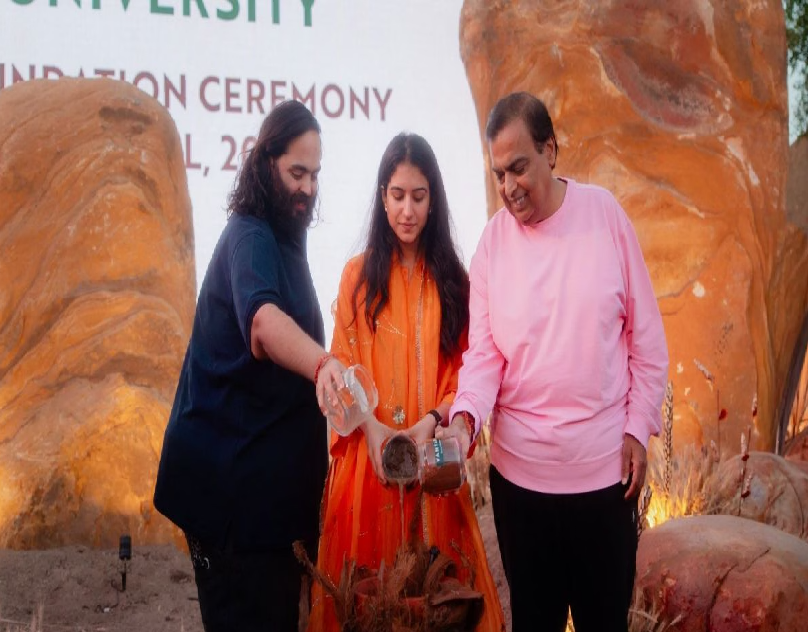
Vantara Launches Global University for Wildlife & Veterinary Sciences
Vantara Launches World’s First Global University for Wildlife and Veterinary Sciences: A New Era in Conservation Education
In a landmark development for global conservation education, Vantara has announced the launch of the world’s first integrated global university dedicated to wildlife conservation and veterinary sciences. The announcement signals a transformative moment in the evolution of specialised higher education, where animal welfare, ecological preservation and advanced veterinary medicine converge within a single academic ecosystem. Established in Jamnagar, Gujarat, the initiative represents an ambitious step towards redefining how the world trains future conservationists, veterinary professionals, and wildlife researchers. With its interdisciplinary approach and strong grounding in real-world conservation practice, the university is poised to become a pioneering centre for scientific learning and environmental stewardship.
A Vision Rooted in Compassion and Scientific Advancement
The foundation of the Vantara University reflects a broader vision of integrating compassion with scientific rigour. Designed as a purpose-driven institution, it aims to nurture professionals who can address the complex challenges of wildlife protection, biodiversity loss and animal health through evidence-based solutions.
The university is envisioned as an academic extension of Vantara’s broader conservation ecosystem in Jamnagar, which is already recognised for its large-scale animal rescue, rehabilitation, and veterinary care infrastructure. By bringing education, research, and field practice under one umbrella, the institution seeks to eliminate the traditional divide between classroom learning and on-ground conservation work.
At its core, the initiative emphasises a holistic philosophy: that the future of conservation depends not only on scientific knowledge but also on empathy, ethical responsibility and a deep understanding of ecological interconnectedness.
Inspired by Ancient Knowledge and Modern Science
One of the most distinctive aspects of the new university is its intellectual inspiration drawn from India’s ancient centres of learning, particularly Nalanda. The academic framework is designed to integrate traditional knowledge systems with cutting-edge scientific research, creating a balanced and globally relevant educational model.
The curriculum is expected to incorporate the One Health approach, which recognises the interdependence of human, animal, and environmental health. This interdisciplinary perspective is increasingly regarded as essential in addressing contemporary challenges such as zoonotic diseases, climate change impacts on biodiversity and habitat degradation.
Students will be exposed to a wide range of subjects including wildlife medicine, veterinary surgery, animal nutrition, behavioural sciences, genetics, epidemiology and conservation policy. This diverse academic offering ensures that graduates are equipped to operate across multiple domains of wildlife science and environmental management.
Bridging the Gap Between Education and Field Practice
A defining feature of Vantara University is its emphasis on experiential learning. Unlike conventional academic institutions, this university is designed to function within a living conservation environment, enabling students to engage directly with rescued and rehabilitated wildlife.
This model allows for continuous interaction between theoretical instruction and practical application. Students will have access to advanced veterinary facilities, wildlife hospitals, rehabilitation centres and research laboratories, ensuring they gain hands-on experience in real-time conservation scenarios.
Such an integrated learning environment is expected to significantly enhance professional readiness, enabling graduates to contribute effectively to wildlife rescue operations, clinical treatment and ecological research from the outset of their careers.
Global Outlook and Leadership in Conservation Education
The university has been described as a global institution, reflecting its ambition to attract students, researchers, and faculty from across the world. By fostering international collaboration, it aims to create a diverse academic community committed to advancing wildlife science and conservation ethics.
The leadership behind the initiative has emphasised the importance of preparing a new generation of professionals capable of addressing global environmental challenges. The focus extends beyond national boundaries, recognising that wildlife conservation is inherently a transnational responsibility.
This global orientation also positions the university as a potential hub for international research partnerships, policy dialogue and knowledge exchange in the fields of veterinary science and biodiversity conservation.
Strengthening India’s Role in Veterinary and Conservation Sciences
India has long held a significant position in veterinary education and animal health research. Institutions such as the Indian Veterinary Research Institute (IVRI) have consistently contributed to global advancements in the field, earning recognition in international rankings for veterinary science.
Against this backdrop, the establishment of Vantara University adds a new dimension to India’s academic landscape. It reflects a growing emphasis on specialised, future-oriented education models that align with both national development goals and global sustainability priorities.
The initiative also complements ongoing efforts within India to integrate traditional knowledge systems with modern scientific research, particularly in areas related to animal care and ecological sustainability.
Emphasis on Ethical and Sustainable Conservation Practices
A central pillar of the university’s philosophy is ethical conservation. The curriculum is expected to highlight responsible wildlife management practices, humane treatment of animals and sustainable ecological interventions.
Students will be trained to critically engage with issues such as habitat preservation, human-wildlife conflict, endangered species protection and environmental policy-making. Ethical considerations will be embedded throughout the academic framework, ensuring that scientific advancement does not occur in isolation from moral responsibility.
This focus on ethics is particularly significant in an era where conservation practices are increasingly scrutinised for their long-term ecological and social impact.
Integration with Advanced Veterinary Infrastructure
The university is closely linked with Vantara’s established veterinary and rehabilitation infrastructure in Jamnagar. This includes advanced animal care facilities, diagnostic laboratories, surgical units and specialised treatment centres for diverse species.
Such integration ensures that students are not only learning from textbooks but are also actively involved in real-world veterinary interventions. This educational model is expected to significantly enhance diagnostic skills, clinical expertise, and research capabilities among graduates.
It also facilitates continuous innovation in wildlife medicine, particularly in areas such as emergency care, disease management and species-specific treatment protocols.
A Milestone in Global Wildlife Education
The launch of Vantara University represents a significant milestone in the evolution of wildlife and veterinary education. It reflects a broader shift towards interdisciplinary, practice-oriented learning models that prioritise real-world impact over purely theoretical instruction.
By combining advanced science with ecological responsibility and compassionate care, the institution seeks to redefine how the world approaches conservation education. Its long-term vision is to produce leaders who are not only technically proficient but also deeply committed to protecting biodiversity and promoting environmental sustainability.
Conclusion: A New Chapter in Conservation Learning
The establishment of the world’s first global university dedicated to wildlife and veterinary sciences marks a bold and forward-looking step in higher education. It embodies a vision where academic excellence, field-based learning and ethical responsibility converge to address some of the most urgent environmental challenges of our time. As the university begins its journey, it carries the potential to reshape global standards in conservation education, inspire new research frontiers and cultivate a generation of professionals equipped to safeguard the planet’s fragile ecological balance. In doing so, it stands not merely as an academic institution, but as a symbol of a new era in which education becomes a direct instrument of environmental healing and global stewardship.