The education sector is navigating two significant challenges: attracting and retaining effective teachers while adapting to the growing influence of artificial intelligence (AI) and digital learning. These themes took centre stage at the South India Educators’ Summit & Dynamic Schools Award, where school leaders exchanged perspectives on building stronger teaching teams and preparing institutions for an evolving educational landscape. Through two panel discussions, the event, covered by Education News Network, explored the importance of teacher development, empathetic leadership, responsible technology adoption, and the preservation of human values in education. Together, the conversations highlighted that meaningful progress requires schools to balance innovation with the relationships and experiences that underpin effective learning.
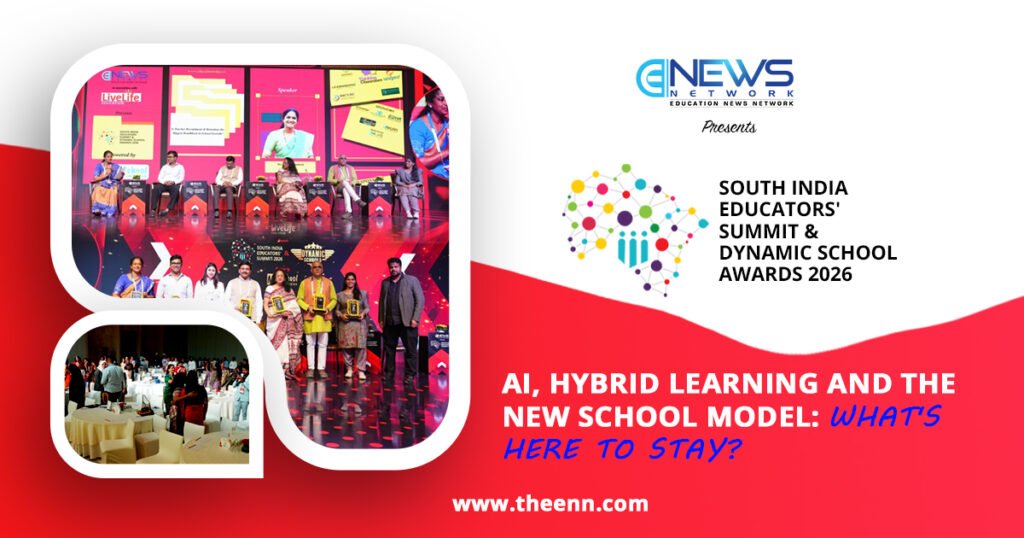
Panel 2: AI, Hybrid Learning and the New School Model: What’s Here to Stay?
The second panel explored how AI and hybrid learning are changing teaching practices, assessment and the design of future schools. Moderated by Ms. Mary Shanti Priya, Principal, Vista International School, the discussion brought together Ms. Sanchita Raha, Principal, CHIREC International School; Dr. Skand Bali, Principal, The Hyderabad Public School; and Ms. Vijaya Lakshmi Dutta, Principal, Westberry School, Tenali.
The panellists acknowledged that AI is becoming an increasingly important part of education. Rather than ignoring its presence, schools must establish responsible ways to use the technology while protecting academic integrity, independent thinking and meaningful teacher-student interaction.
Dr. Skand Bali emphasised that technological progress makes the teacher’s role more significant, not less. AI can assist with lesson planning and explaining concepts, but teachers remain responsible for providing context, encouraging critical thinking, and making learning inclusive. Continuous professional development is essential to help educators use digital tools effectively without losing sight of students’ individual needs.
Ms. Vijaya Lakshmi Dutta highlighted the importance of teaching students to use AI responsibly. Clear expectations, digital-safety awareness, and appropriate safeguards can help schools address concerns around plagiarism, misuse, and overdependence on automated tools. Teachers must also possess strong subject knowledge to guide students in evaluating information rather than accepting AI-generated responses uncritically.
Ms. Sanchita Raha addressed the need to reconsider assessment in an AI-enabled environment. When students can use AI to produce essays, presentations and project reports, evaluating the final submission alone may not reveal the depth of their understanding. Schools should place greater emphasis on students’ reasoning, their ability to apply knowledge to real-world situations and the thinking behind their work. Critical thinking, problem-solving and academic integrity must remain central to assessment practices.
The discussion also examined how schools should evolve in response to technological change. Dr. Bali advocated balancing digital innovation with experiential learning and community-based practices associated with traditional Indian education. Outdoor activities, collaboration, environmental awareness, and face-to-face engagement continue to play an important role in students’ development. Digital learning should complement these experiences rather than displace them.
Ms. Dutta highlighted the lessons of hybrid learning, particularly the importance of adaptability. Schools must remain open to new teaching methods while ensuring technology serves educational objectives. Collaboration between schools and families is equally important, especially when addressing digital safety, setting appropriate boundaries, and guiding students’ technology use.
Building Schools That Balance People and Progress
The overall discussions at the South India Educators’ Summit & Dynamic Schools Award highlighted the importance of combining institutional adaptability with a strong human foundation. Effective recruitment, fair compensation, continuous professional development and empathetic leadership are essential to retaining teachers. Meanwhile, AI and hybrid learning require thoughtful implementation, with assessments designed to recognise understanding, critical thinking and practical application. For EducationNewsNetwork, the discussions offered a timely perspective on the priorities facing school leaders. Technology may change how education is delivered, but teachers remain central to how students learn, develop values and prepare for the future. Schools that invest in their educators while embracing innovation responsibly will be better equipped to meet the changing needs of learners.
AI is supporting personalised learning, assisting teachers, and providing new ways to create engaging educational experiences.
Hybrid learning combines traditional classroom instruction with digital learning tools and online educational experiences.
It offers flexibility, expands access to learning resources, and allows schools to combine face-to-face interaction with digital instruction.
AI can support individual learning needs, provide learning assistance, and help teachers manage certain academic tasks.
Technology integration, flexible learning approaches, teacher development, student well-being, and skill-based education will influence future school models.