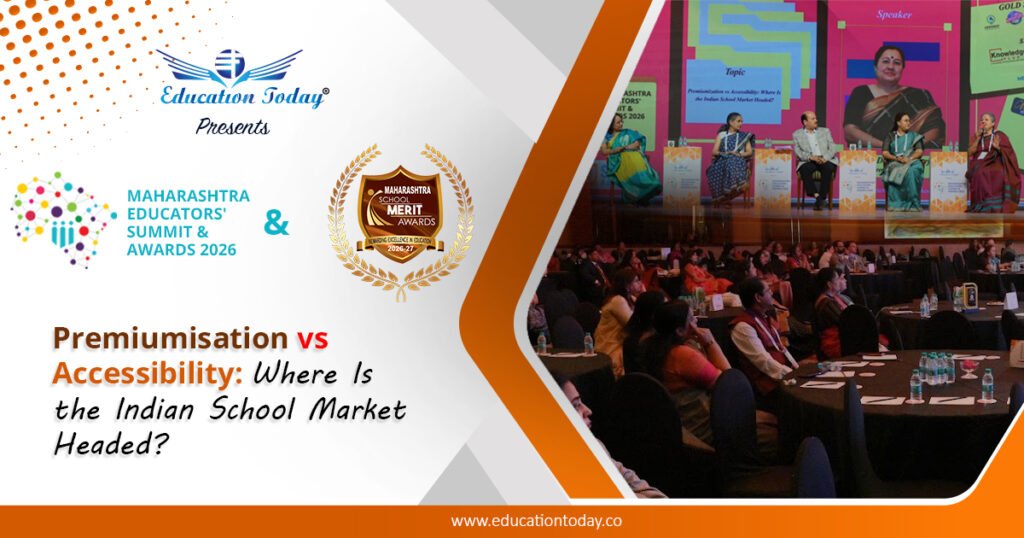

Schools today face a rapidly changing educational landscape shaped by technological advancements, evolving student needs, changing societal expectations, and global uncertainties. Building resilient institutions requires school leaders to prepare students for unforeseen challenges while maintaining a strong foundation of values, adaptability and holistic learning. These themes took centre stage at the North Educators’ Summit and Awards 2026, organised by EducationToday, during a panel discussion titled ‘Building Resilient Schools in an Unpredictable World’. The discussion brought together experienced education leaders to examine how schools can strengthen their educational philosophies, encourage innovation and prepare learners to navigate an uncertain future. Through their diverse perspectives, the panellists highlighted the importance of consciousness-based education, student well-being, flexible teaching approaches, responsible leadership, and the preservation of human values.
Panel 2: Building Resilient Schools in an Unpredictable World
Moderated by Dr. Sangeeta Bhatia, Principal of KIIT World School, New Delhi, the panel featured Ms. Anjali Jaipuria, Founder of Seth M.R. Jaipuria School; Mr. Maahir Madhok, Director of Dalimss Sunbeam Group of Schools; Ms. Priya Elizabeth John, Principal of Delhi Public School, Indirapuram; and Mrs. Ruchi Pradhan Datta, Headmaster of The Lawrence School, Sanawar. The discussion explored the qualities that enable schools to remain responsive during periods of change while ensuring that students receive a balanced and meaningful education.
Dr. Sangeeta Bhatia brought more than 30 years of experience in school education and leadership to the discussion. As Principal of KIIT World School, New Delhi, and a recipient of the National Award for Education from the Ministry of Education, she advocates student-centric learning, global awareness, and value-driven education. Her leadership philosophy emphasises purposeful action and the development of adaptable, ethical and future-ready learners. These priorities reflect the importance of preparing schools to respond proactively to global challenges, including sustainability and responsible citizenship, while maintaining a clear educational vision.
Ms. Anjali Jaipuria highlighted the importance of rethinking conventional approaches to education through consciousness-based learning. As Founder of Seth M.R. Jaipuria School, she has worked towards integrating Indian knowledge systems with contemporary pedagogy. Her engagement with Vedic literature, the Upanishads, the Bhagavad Gita, and the educational philosophy of Sri Aurobindo informs her approach to learning and personal development. Her perspective offers an important dimension to the discussion on resilience: education must nurture self-awareness, values and a deeper understanding of human development alongside academic knowledge. Such an approach can help students develop the inner resources needed to navigate uncertainty and make thoughtful decisions.
Mr. Maahir Madhok brought a leadership perspective shaped by his experience across education, media and wellness. Serving as Director of Dalimss Sunbeam Group of Schools, he focuses on building a culture of excellence, innovation and social responsibility. His professional experience highlights the importance of effective organisational management and the ability to respond to changing expectations. For schools, resilience involves creating environments in which educators, students and staff can adapt to new challenges while continuing to work towards shared objectives. Innovation and institutional development must therefore be supported by a clear commitment to meaningful learning and collective progress.
Ms. Priya Elizabeth John emphasised the importance of holistic, skills-based and value-driven education. With more than three decades of experience in education and administration, she advocates flexible pedagogies, student-centric learning and innovation in line with the National Education Policy (NEP). Her approach highlights the need for schools to move beyond conventional academic frameworks and equip students with skills that remain relevant in changing circumstances. By encouraging independent thinking, adaptability and social sensitivity, schools can help learners develop the confidence to respond to challenges. Flexible teaching methods also allow educators to address diverse learning needs while maintaining academic rigour and personal development as complementary priorities.
Mrs. Ruchi Pradhan Datta brought extensive academic, administrative, and communication experience to the discussion. Having worked with several reputed educational institutions, she advocates an educational philosophy centred on “drawing out, not drilling in”. Her leadership journey includes heading The Lawrence School, Sanawar, where she became the first woman Headmaster in the school’s 179-year history. Her philosophy underscores the importance of recognising individual potential rather than relying solely on instruction and rote learning. Resilient schools must create opportunities for students to question, explore, communicate and develop their abilities. This approach supports independent thought and prepares learners to face unfamiliar situations with confidence and responsibility.
Building Schools That Balance Stability and Change
The panel discussion at the North Educators’ Summit and Awards 2026 reinforced the idea that resilient schools are built through a combination of strong leadership, adaptable teaching practices and a clear commitment to student development. While educational institutions must respond to technological, social and academic changes, their fundamental responsibility remains to nurture capable, ethical and responsible individuals.
The conversation also highlighted that resilience cannot be achieved through infrastructure or innovation alone. It requires educational leaders to empower teachers, encourage independent thinking, preserve meaningful values and create supportive environments where students can grow. By bringing together diverse perspectives on leadership, educational philosophy, and student-centric learning, the summit provided a platform for examining how schools can remain responsive without losing sight of their purpose.
Ultimately, the discussion highlighted the importance of preparing schools not merely to withstand uncertainty but to use changing circumstances as opportunities for growth. Institutions that balance innovation with human values and academic development with emotional and social learning will be better positioned to prepare students for an unpredictable world.
Building resilient schools means creating educational institutions that can adapt to unexpected challenges, manage disruptions, and maintain a supportive learning environment.
Resilience helps schools respond effectively to academic, technological, social, and operational challenges while ensuring continuity in teaching and learning.
School leaders guide decision-making, encourage innovation, support teachers, strengthen communication, and develop strategies to manage unexpected situations.
Schools can invest in teacher development, digital infrastructure, emergency preparedness, flexible learning approaches, and strong partnerships with parents and communities.
Teachers contribute by adapting teaching methods, supporting students emotionally, encouraging problem-solving, and creating inclusive classrooms that help students navigate challenges confidently.