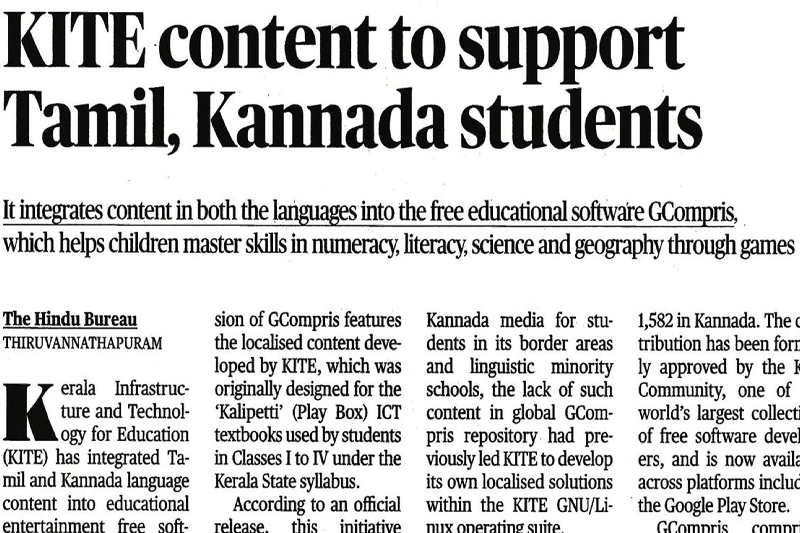
KITE Integrates Tamil and Kannada Content into GCompris, Boosting Multilingual Digital Learning
In a development that underscores Kerala’s enduring commitment to inclusive and technology-driven education, Kerala Infrastructure and Technology for Education (KITE) has successfully integrated Tamil and Kannada content into GCompris, one of the world’s most respected educational entertainment platforms for young learners. The initiative marks a significant milestone not only for the state’s education system but also for the global Free and Open Source Software (FOSS) community.
Expanding Linguistic Access in Early Education
GCompris, a comprehensive educational suite comprising nearly 200 interactive activities, is designed to support children up to the age of ten in developing foundational competencies in numeracy, literacy, science, geography and logical reasoning. Its play-based architecture has made it a preferred resource in schools and homes across continents.
Until recently, Indian language support within GCompris was largely confined to Sanskrit and Malayalam. The addition of Tamil and Kannada represents a meaningful expansion of linguistic accessibility, ensuring that a wider cohort of children can engage with digital learning tools in their mother tongue. For a multilingual nation such as India, such inclusivity is not merely symbolic; it is pedagogically vital.
KITE, functioning as the technology arm of Kerala’s General Education Department, undertook the localisation exercise in alignment with its commitment to equitable educational access. The content was originally developed to complement Kalipetti ICT textbooks used by students in Classes 1 to 4 under the Kerala state syllabus.
Addressing a Practical Educational Need
Kerala provides textbooks in Tamil and Kannada for students in border districts and linguistic minority schools. However, the absence of corresponding digital content within the global GCompris repository presented a gap in the ecosystem. While Malayalam-language resources were readily available, Tamil- and Kannada-speaking learners lacked equivalent digital reinforcement.
To bridge this divide, KITE initially developed localised solutions within its own GNU/Linux operating suite. The work was not conceived as a purely regional initiative, but as a contribution rooted in practical necessity. The ambition, however, extended beyond local deployment.
The opportunity for global integration arose following a visit last October by Timothée Giet, a French graphics artist, co-maintainer of GCompris and lead developer of Krita software. During his visit to KITE, Giet encouraged the team to upload their localisation packages to the official GCompris repository, thereby making them accessible to users worldwide.
A Rigorous Localisation Effort
The scale of the localisation exercise is noteworthy. KITE prepared 1,544 graphical user interface (GUI) translations and voice-overs in Tamil, and 1,582 in Kannada. This was not a superficial translation endeavour but a comprehensive adaptation involving text elements, instructions, prompts and audio support.
Such meticulous localisation ensures that children are not merely navigating translated menus, but engaging meaningfully with the software’s pedagogical intent. The presence of accurate voice-overs is particularly significant for early learners, many of whom are still acquiring reading fluency.
Following submission, the contribution underwent formal review and was subsequently approved by the KDE Community, one of the largest global collectives of free software developers. With this endorsement, the Tamil and Kannada packages have been integrated into the official GCompris repository and are now available across platforms, including the Google Play Store.
Kerala’s Leadership in Free Software for Education
Kerala has long been recognised as a pioneer in the large-scale adoption of Free Software within public education. The state’s systematic integration of GNU/Linux-based systems into government schools represents one of the most extensive implementations of FOSS in a defined geographic region.
KITE’s latest contribution reinforces this leadership. Rather than merely consuming open-source resources, Kerala has actively contributed back to the global community. This reciprocal engagement exemplifies the ethos of Free Software i.e - collaboration, transparency and shared advancement.
KITE CEO K Anvar Sadath has expressed pride in this achievement, noting that Kerala’s experience in deploying Free Software at scale has positioned it uniquely to enrich the global FOSS ecosystem. By contributing locally developed resources, the state has demonstrated that innovation need not be confined to proprietary platforms.
Pedagogy Through Play
At its core, GCompris embodies the principle that young children learn most effectively through structured play. Activities range from basic arithmetic puzzles and reading exercises to scientific exploration and geographical awareness tasks. The software’s design encourages curiosity, experimentation and self-directed learning.
By integrating Tamil and Kannada content, KITE has ensured that children who speak these languages can experience the same immersive educational journey as their peers. Language, especially at the primary stage, is intimately connected with cognitive development. Access to digital resources in one’s native tongue strengthens comprehension and confidence.
The localisation also aligns with broader educational philosophies that advocate mother-tongue instruction during early schooling years. Digital tools that reinforce classroom instruction in regional languages can significantly enhance learning outcomes.
Inclusive and Offline-Ready Technology
Another notable aspect of GCompris is its client-server model, which functions effectively without continuous internet connectivity. KITE is leveraging this feature to benefit children with special needs and those in areas with limited digital infrastructure.
In regions where stable internet access cannot be guaranteed, offline-capable educational software becomes indispensable. The ability to deploy high-quality digital learning resources without dependency on connectivity ensures equitable reach.
Furthermore, adaptations within the platform can be tailored to accommodate learners with diverse needs. Technology, when thoughtfully implemented, can become a powerful equaliser in the classroom.
A Model for Regional Contribution to Global Platforms
The integration of Tamil and Kannada content into GCompris offers a compelling model for other states and educational bodies. Rather than waiting for global platforms to localise content, regional agencies can take proactive steps to develop and contribute language resources.
Such initiatives not only serve local learners but also enrich the global repository of educational tools. Open-source communities thrive on collaborative input, and contributions from diverse linguistic and cultural contexts strengthen the ecosystem as a whole.
Kerala’s approach demonstrates that public institutions can operate at the intersection of local responsiveness and global engagement. By identifying a gap, developing a solution and sharing it widely, KITE has set a precedent for participatory innovation.
Beyond Software: A Philosophy of Shared Knowledge
The significance of this development extends beyond technical integration. It reflects a philosophy that views knowledge as a shared public good. In an era dominated by proprietary educational technologies, the sustained investment in Free Software underscores an alternative vision, one rooted in accessibility, adaptability and communal progress.
For students in Classes 1 to 4 using Kalipetti ICT textbooks, the integration ensures seamless reinforcement between printed and digital content. For the global community, it signals that Indian regional languages have a rightful place within international educational platforms.
Looking Ahead
As digital learning continues to evolve, the importance of culturally and linguistically inclusive resources will only grow. KITE’s integration of Tamil and Kannada content into GCompris is a reminder that meaningful innovation often lies in bridging local needs with global platforms.
By contributing over 3,000 translations and voice assets collectively, Kerala has not merely expanded a software suite; it has advanced the cause of equitable digital education. The initiative stands as a testament to what can be achieved when public institutions combine technical expertise with a commitment to inclusivity.
In reaffirming its leadership in Free Software adoption and contribution, Kerala has once again demonstrated that educational transformation is as much about collaboration as it is about technology.