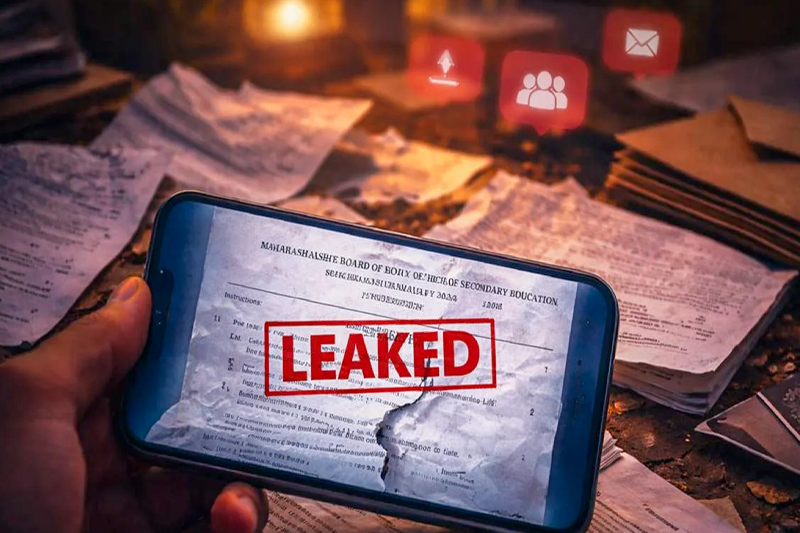
No Leak In Maharashtra HSC Chemistry Exam, Board Clarifies Amid Rumours
The recent circulation of the Maharashtra HSC Chemistry question paper in a WhatsApp group shortly before the commencement of the examination has stirred concern among students, parents and educators alike. However, authorities have firmly clarified that the incident does not constitute a paper leak, and that the Higher Secondary Certificate (HSC) examinations will proceed as scheduled without any re-examination.
The Maharashtra State Board of Secondary and Higher Secondary Certificate moved swiftly to address mounting speculation after two individuals were arrested in Nagpur in connection with the circulation of the question paper. Officials have emphasised that while the sharing of the paper image was a serious breach of examination protocol, it was limited in scope and did not compromise the integrity of the examination process at a systemic level.
The Incident: What Happened?
The matter came to light on February 18 in the Mankapur area of Nagpur during the Chemistry examination, which was scheduled to begin at 11 am. An invigilator at St Ursula’s College grew suspicious when a student remained in the washroom for nearly 20 minutes during the course of the exam. Acting on this suspicion, authorities conducted a frisking procedure and discovered that the student was carrying a mobile phone inside the examination hall, a clear violation of examination rules.
Upon examining the device, officials found that an image of the Chemistry question paper had been received in a WhatsApp group between 10:37 am and 10:40 am, shortly before the examination commenced. Further inquiry revealed that the Physics question paper, conducted on February 16, had also been shared earlier in the same group.
Approximately 12 students were reportedly members of the group. Police investigations led to the arrest of two individuals, one allegedly associated with a small tuition centre and another a member of the WhatsApp group where the paper was circulated. Authorities have stated that the identities of the accused will not be disclosed at this stage, as investigations are ongoing to trace the primary source of the circulation.
No Evidence of Systemic Leak
Despite the alarming optics of the situation, board officials have categorically clarified that the episode does not amount to a question paper leak in the conventional sense. According to preliminary findings, the circulation was confined to a single WhatsApp group and did not spread widely across examination centres.
Crucially, officials confirmed that the student found with the mobile phone did not open the image of the question paper during the examination. Although she reportedly noticed the message notification during initial checks, she did not access the content and was unable to use the device while writing the paper. This detail has been central to the board’s decision not to order a re-examination.
Authorities further stated that students have not yet been formally questioned because the board examinations are still underway. Any such questioning, they indicated, would be conducted with sensitivity and in accordance with due procedure, once the examination cycle concludes.
The Board’s Stand: No Re-Examination
In a clear and measured response, the board has confirmed that the HSC examinations will continue as scheduled. The circulation of the paper, being limited in scale and impact, does not warrant the disruption and anxiety that would accompany a re-test for thousands of students.
This decision reflects an attempt to balance accountability with fairness. Re-examinations carry significant emotional and logistical consequences, extending stress for students, straining administrative resources and potentially disrupting academic calendars. By determining that no unfair advantage was gained and that the breach was contained, the board has sought to preserve stability in the examination process.
The Broader Context: Examination Integrity in the Digital Age
The incident also highlights the evolving challenges faced by examination authorities in an era of ubiquitous digital communication. Mobile phones and instant messaging platforms have amplified both the speed and reach of information dissemination. Even a limited breach can quickly trigger rumours of systemic failure, particularly during high-stakes board examinations.
In recent years, education boards across the country have strengthened security protocols, including restricted entry policies, frisking procedures, CCTV surveillance and strict bans on electronic devices. The fact that the student in question was detected and that authorities acted promptly demonstrates the vigilance of examination invigilation systems.
Yet the episode also underscores the persistent risks posed by unauthorised devices within examination halls. While the board has reiterated existing rules prohibiting mobile phones and electronic gadgets, the incident may prompt renewed scrutiny of enforcement mechanisms at the ground level.
Responsibility Beyond the Examination Hall
Another dimension of the case involves the alleged link to a small tuition centre. Although details remain under investigation, the possibility that coaching or tuition networks could become conduits for unauthorised sharing raises ethical questions about academic competition and pressure.
Examinations like the HSC are pivotal milestones in a student’s academic journey. The pressure to perform well can sometimes create vulnerabilities that unscrupulous individuals attempt to exploit. It is therefore imperative that stakeholders including educators, coaching institutions and parents, reinforce values of integrity and fair play.
The board’s response sends a dual message: misconduct will be investigated and addressed, but decisions will be grounded in evidence rather than speculation.
Avoiding Panic and Preserving Trust
Perhaps the most significant outcome of the board’s clarification is the containment of panic. In the age of social media, rumours can spread far more rapidly than verified information. The phrase “paper leak” carries profound implications, not only for the credibility of the examination system but also for the emotional well-being of students.
By promptly clarifying that no leak occurred and that no re-examination will take place, authorities have attempted to reassure students and families. Stability and trust in public examination systems are hard-won assets, and swift communication plays a crucial role in safeguarding them.
Looking Ahead
As investigations continue to identify the origin of the circulation, the immediate priority remains the smooth conduct of the ongoing HSC examinations. Law enforcement agencies are working to trace the primary source of the shared content, and further action will likely follow once the inquiry is complete.
The episode serves as a reminder that vigilance, transparency and proportionate response are essential in maintaining the sanctity of large-scale examinations. While breaches of protocol must be treated seriously, measured decision-making is equally vital to avoid unnecessary disruption.
In reaffirming that the Maharashtra HSC Chemistry examination remains valid and that students need not fear a re-test, the board has sought to restore confidence at a crucial juncture. The message is clear: integrity will be upheld, but fairness to students will remain paramount.