Caught in Limbo: The Seven-Year Standstill in Uttar Pradesh’s 69,000 Teachers’ Recruitment
In the labyrinthine world of government recruitment in India, few controversies have stirred as much frustration, bewilderment and socio-economic anxiety as the prolonged impasse over the recruitment of 69,000 assistant teachers in Uttar Pradesh. What was intended to be a milestone in expanding educational access has instead become an emblem of judicial gridlock and administrative inertia, leaving thousands of qualified aspirants suspended in professional purgatory for almost a decade.
The genesis of this saga lies in a recruitment exercise announced on 6 December 2018, followed by an examination on 6 January 2019 and the announcement of results in June 2020. On the surface, the sequence appeared methodical; yet beneath it simmered disputed interpretations of reservation rules and procedural compliance. What began as an earnest attempt to bolster the teaching cadre in India’s most populous state has since evolved into a protracted legal battle with profound human consequences.
The Backdrop: Aspirations, Opportunities and Early Controversy
At the heart of this controversy lies the state’s attempt to address chronic shortages in government primary and elementary schools, a lacuna that affects learning outcomes, teacher-pupil ratios and, ultimately, educational equity. Across Uttar Pradesh’s districts, a desperate demand for stable government teaching positions propelled tens of thousands of candidates to appear for the 2019 examination, many leaving behind other employment or academic pursuit in hope of securing a career-defining role.
Initial optimism, however, quickly gave way to scepticism when objections were raised by candidates from reserved categories, who argued that reservation norms had not been implemented properly. These objections ignoring neither the letter nor spirit of reservation policy eventually traversed a complex judicial trajectory: from committees on backward classes to the Allahabad High Court, and ultimately to the Supreme Court of India.
Legal Gridlock: A Process, Not a Verdict
By September 2024, the matter had assumed national prominence as general category candidates petitioned the Supreme Court challenging the High Court’s decision to direct a revised merit list. In response, the apex court stayed the entire recruitment process until further orders, effectively halting appointments and leaving aspirants in a state of indefinite waiting.
As of early 2026, the case has been listed for hearings on no fewer than 28 occasions over roughly a year and a half, with successive dates issued but no substantive resolution delivered. For many aspirants, the continuance of this cycle of “dates after dates” has come to symbolise administrative paralysis and judicial hesitation to provide finality.
Indeed, the protesters themselves have voiced a simple, existential complaint: not that they seek any particular verdict in their favour, but that they crave closure. “Whether we get the job or not, this uncertainty must end,” says one candidate whose formative years have been consumed by litigation rather than classroom instruction.
Protests in the Capital: Voices of the Waiting Generation
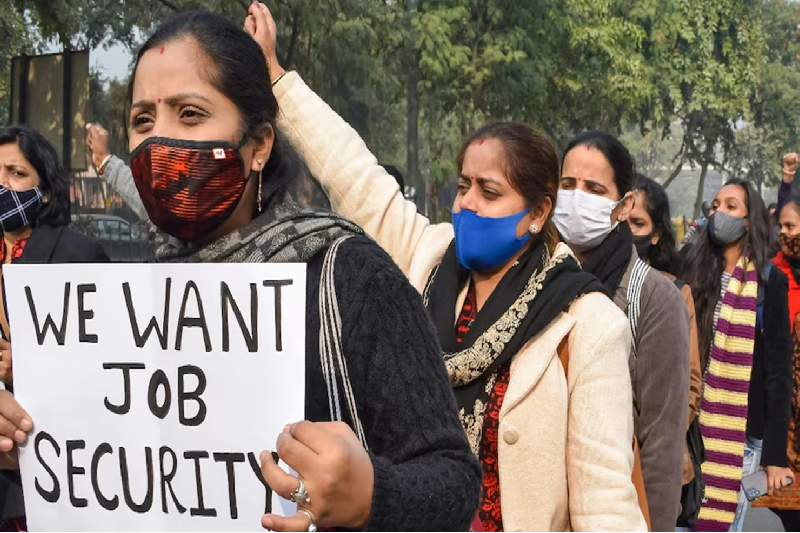
On a recent Monday in Lucknow, the scale of frustration manifested in a public demonstration outside the official residence of the state’s Deputy Chief Minister, Keshav Prasad Maurya. Hundreds of aspirants, some for years educated, some balancing familial responsibilities, and some having sacrificed prior employment for this opportunity, gathered under banners, chanting demands for decisive action.
Their grievances go beyond the judiciary’s pace. Protesters accuse the state government of failing to mount effective legal defence or assertive argumentation on their behalf in the Supreme Court, a lapse they contend has compounded the delay. Some say that despite favourable interim pronouncements from High Courts, such decisions remain unimplemented as a result of this absence of government advocacy.
Several candidates speak with poignant candour about the personal toll of years without employment. “I prepared rigorously for this opportunity,” says Anupama Singh from Kanpur, her voice lined with both resolve and exhaustion. “Now, we have spent years in uncertainty. Courts give dates, but no decision. Our lives remain on hold.”
Another aspirant, Ayushi Patel, highlights how the delay has altered her life’s rhythm, her days divided between exam preparation and raising three children, all the while financing legal costs through contributions from a close-knit community of peers.
Parallel Struggles: Stalled Recruitment Beyond Teaching
The paralysis afflicting the teacher recruitment exercise is not isolated. Another significant recruitment process for 1,002 Ayurvedic pharmacists in government hospitals and colleges has also descended into legal limbo. Originally notified on 1 February 2024 and attracting over 2,000 applicants, this process remains incomplete nearly two years later due to objections and subsequent petitioning in the Allahabad High Court under disputed revised rules.
In that case, the upheaval stems from a policy change in recruitment norms — from a seniority-based system to one incorporating competitive testing — which candidates trained under the old system allege unfairly disadvantaged them. This too highlights a broader administrative challenge: how best to balance procedural fairness, adherence to policy reform, and timely execution of recruitment drives.
Intersection of Law, Policy and Reality
At its core, the 69,000 teachers’ recruitment dispute raises intricate questions about legal procedure, the rule of law and the rights of aspirants whose careers hinge on transparent and predictable systems. The judiciary, rightly cautious in adjudicating matters of policy and statutory compliance, must nonetheless reconcile its pace with the real-time exigencies of candidates’ livelihoods and aspirations. Meanwhile, the government as a party to this litigation bears responsibility for championing its policy position and facilitating timely resolutions.
Observers note that judicial delays are endemic in India’s legal system, especially in cases involving large recruitments that attract competing claims from diverse groups. However, the perception among many aspirants is that effective state representation could expedite hearings and perhaps help bring closure to what has become an extraordinary chapter of professional limbo.
Aspirants’ Plight: Beyond Employment
For those caught in this prolonged wait, the impact is more than economic. It seeps into psychological well-being, family planning and broader social engagement. Some candidates report feelings of stagnation, disillusionment and erosion of trust in state institutions. Others speak of sacrificing opportunities both academic and personal in the hope that stability might emerge.
Indeed, the human cost of this stalemate transcends metrics like vacancies filled or posts sanctioned. It speaks to an entire generation’s relationship with meritocracy, aspiration and institutional accountability. As one aspirant put it, “We are not merely asking for jobs; we are asking for justice.”
Legal Context and Prospects
Legal commentators suggest that there are multiple layers to this dispute that complicate simple resolutions. Reservations, merit lists, procedural compliance and retrospective interpretations of policy all intertwine to form a dense tapestry of legal questions. Moreover, once a matter is before the Supreme Court, judicial discretion often dictates the pace of hearings and judgments, underscoring the need for governments to present cogent, thorough arguments to ensure that justice is both done and seen to be done.
The cumulative effect of these intertwined disputes, where aspirants from multiple recruitment exercises confront parallel uncertainties, may ultimately prompt proposals for systemic reforms, including clearer timelines for litigation, stronger mechanisms for administrative review, and perhaps alternative dispute resolution avenues for mass recruitments.
Conclusion: Breaking the Cycle of Uncertainty
The impasse over Uttar Pradesh’s 69,000 teachers’ recruitment is about more than numbers. It has become a stark symbol of how policy intentions, when ensnared in procedural complexity, can inadvertently create human costs that ripple across years and generations. Aspiring teachers have demonstrated remarkable resilience, alternating between protest, petition and personal perseverance. Yet their central plea remains profoundly simple: an end to uncertainty and a definitive resolution, whether favourable or not to a process that has overshadowed years of their lives.
As the Supreme Court resumes hearings and state authorities reaffirm their positions, the hope of thousands rests on the promise of finality. For these aspirants, closure is not merely a legal outcome; it is a necessary precondition for dignity, progress and the fulfilment of their professional calling.