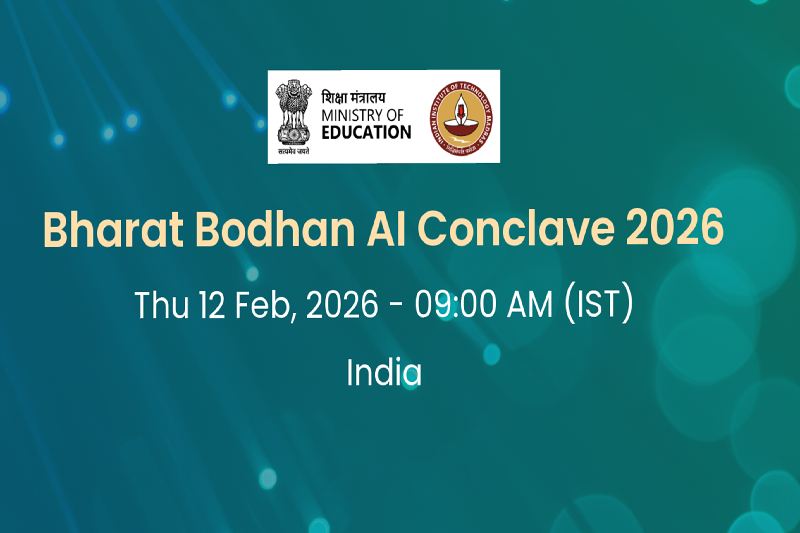
Education Ministry's Bharat Bodhan AI Conclave 2026 Scheduled For February 12–13 - Top News
India’s education sector stands at a transformative juncture where technological innovation, policy reform, and evolving learning needs increasingly intersect. In this context, the Ministry of Education’s forthcoming Bharat Bodhan AI Conclave 2026, scheduled for 12–13 February at Bharat Mandapam in New Delhi, represents a significant national initiative aimed at exploring the role of artificial intelligence (AI) in shaping the future of education. Positioned as a precursor to the India AI Impact Summit, the conclave is expected to convene policymakers, academic leaders, technology innovators, industry stakeholders, and researchers to deliberate on how AI can responsibly and inclusively enhance educational outcomes across the country.
The event is being spearheaded by the Centre of Excellence in Artificial Intelligence for Education, established at the Indian Institute of Technology Madras under the banner of the IIT Madras Bodhan AI Foundation. The Centre carries a national mandate to develop scalable, responsible, and India-focused AI solutions tailored to the country’s diverse educational landscape. By aligning technological innovation with national educational priorities, the initiative aims to foster both accessibility and quality in learning experiences.
The Emergence of AI in Education
Artificial intelligence has rapidly transitioned from a theoretical concept to a transformative force across sectors, including healthcare, finance, manufacturing, and increasingly, education. Its potential applications in education are vast: adaptive learning platforms, personalised assessment tools, automated administrative systems, intelligent tutoring technologies, and data-driven decision-making frameworks.
For a country as vast and diverse as India, AI offers opportunities to address longstanding educational challenges. Variations in language, socio-economic status, geographic access, and resource availability have historically influenced educational equity. AI-enabled solutions, when thoughtfully designed, can help bridge these disparities by delivering customised learning experiences and scalable educational support.
The Bharat Bodhan AI Conclave seeks to position India at the forefront of this technological evolution while ensuring that ethical considerations, inclusivity, and pedagogical effectiveness remain central to AI adoption.
A National Platform for Strategic Collaboration
At its core, the conclave is intended as a national platform for strategic partnership-building. By bringing together stakeholders from government, academia, startups, industry, philanthropic organisations, and the edtech ecosystem, the event aims to facilitate dialogue that transcends institutional boundaries.
Such collaboration is crucial because educational transformation rarely occurs in isolation. Effective AI integration requires interdisciplinary expertise, robust policy frameworks, technological innovation, and ground-level implementation. By fostering partnerships among these diverse actors, the conclave aims to accelerate the development and deployment of AI-enabled educational solutions.
Moreover, the platform is designed not only for discussion but also for actionable outcomes. Demonstration stalls, structured feedback mechanisms, and direct engagement with policymakers provide participants with opportunities to showcase innovations, receive expert insights, and refine their initiatives.
Alignment with NEP 2020
The conclave’s timing is particularly relevant in light of India’s National Education Policy (NEP) 2020, which emphasises technological integration, multidisciplinary learning, digital literacy, and lifelong education. NEP 2020 envisions an education system that is flexible, inclusive, and responsive to global technological trends while remaining rooted in local contexts.
Artificial intelligence aligns naturally with these objectives. It can support competency-based education, facilitate multilingual learning, enhance teacher training, and enable data-informed policy decisions. Discussions at the conclave are expected to explore how AI can operationalise NEP principles at scale, ensuring that technological advancements translate into tangible educational benefits.
Focus Areas and Priority Verticals
Submissions for participation in the conclave were invited across four priority verticals: AI for school education, AI for higher education, AI for skilling and workforce readiness, and AI research and deep technology. These categories reflect the multifaceted nature of AI’s potential impact on education.
In school education, AI applications may include adaptive learning tools, early assessment diagnostics, and personalised educational content. Such innovations can help address learning gaps and enhance foundational skills among students.
In higher education, AI can support advanced research, interdisciplinary collaboration, curriculum innovation, and career guidance systems. Universities increasingly recognise the importance of integrating AI literacy into academic programmes to prepare students for emerging professional landscapes.
Skilling and workforce readiness constitute another critical area. As automation reshapes employment patterns, continuous skill development becomes essential. AI-driven platforms can deliver targeted training, career mapping, and competency assessments aligned with evolving industry demands.
Finally, AI research and deep technology remain central to innovation. Encouraging indigenous research capabilities ensures that AI solutions are culturally relevant, ethically grounded, and responsive to national priorities.
Ensuring Responsible and Inclusive AI
While AI offers considerable promise, it also raises ethical, regulatory, and societal questions. Issues such as data privacy, algorithmic bias, accessibility, and digital exclusion must be addressed proactively. The IIT Madras Bodhan AI Foundation’s mandate emphasises responsible AI development, ensuring that technological innovation does not inadvertently reinforce existing inequities. Inclusivity is particularly crucial in the Indian context. Educational technologies must accommodate linguistic diversity, regional disparities, and varied socio-economic backgrounds. AI systems designed for urban, English-speaking populations may not automatically translate to rural or multilingual environments. Hence, the conclave’s emphasis on “India-first” AI solutions reflects a commitment to contextual relevance.
Opportunities for Innovators and Stakeholders
Selected participants in the conclave will receive national-level visibility and the opportunity to present their solutions to a diverse audience, including policymakers, academic leaders, investors, and industry representatives. Such exposure can catalyse partnerships, funding opportunities, and broader adoption of innovative educational technologies.
The structured feedback process involving educators, learners, and expert committees further enhances the value of participation. Constructive critique can help innovators refine their solutions, ensuring that technological developments align with pedagogical realities and user needs.
Teacher Empowerment and Professional Development
AI integration in education is not solely about student-facing technologies. Teacher empowerment remains equally vital. AI-driven analytics can assist educators in identifying learning gaps, tracking student progress, and tailoring instructional strategies. Professional development programmes leveraging AI can also support teachers in adapting to evolving pedagogical methods. By addressing teacher readiness alongside technological innovation, the conclave acknowledges that sustainable educational transformation requires human expertise complemented by technological support.
Broader Implications for India’s Education Ecosystem
The Bharat Bodhan AI Conclave arrives at a time when India is actively positioning itself as a global technology leader. Integrating AI into education aligns with national economic aspirations, workforce development strategies, and innovation goals.
A robust AI-enabled education ecosystem can enhance research output, attract international collaboration, and strengthen India’s competitiveness in emerging technological sectors. It also contributes to building a digitally literate citizenry capable of navigating complex information environments responsibly.
Looking Ahead
As the conclave approaches, expectations are high that it will catalyse meaningful dialogue and actionable outcomes. The success of such initiatives, however, will ultimately depend on sustained commitment beyond the event itself. Policy implementation, continuous research, infrastructure investment, and stakeholder collaboration will be essential to translate discussions into measurable impact.
Nevertheless, the Bharat Bodhan AI Conclave 2026 symbolises a forward-looking vision for Indian education, one that embraces technological innovation while remaining attentive to ethical, social, and pedagogical considerations. By fostering collaboration, encouraging innovation, and prioritising inclusivity, the initiative has the potential to shape the trajectory of AI-enabled education in India for years to come.
In an era defined by rapid technological change, such platforms are not merely conferences; they are catalysts for transformation. If guided thoughtfully, the convergence of artificial intelligence and education could redefine learning experiences, expand opportunities, and empower future generations to navigate an increasingly complex world with confidence and competence.