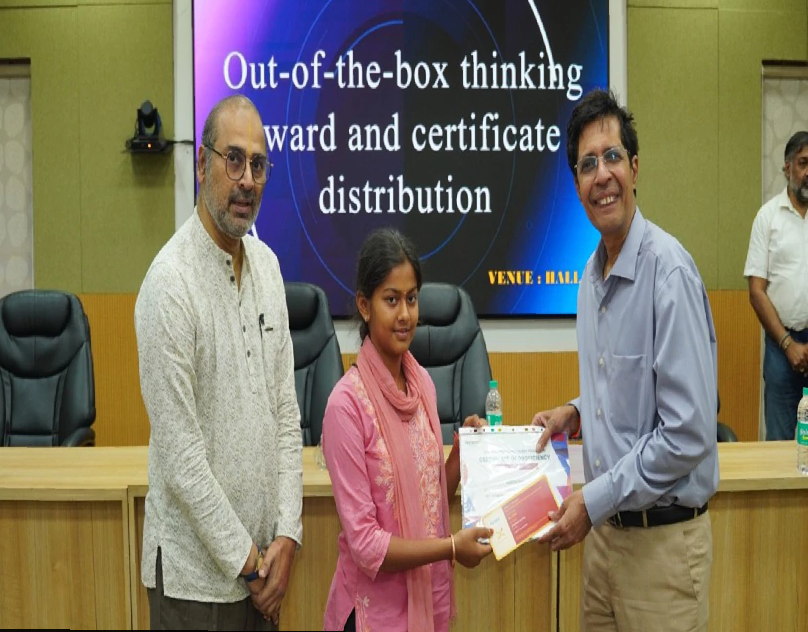
IIT Madras Pravartak’s Free OOBT Programme Inspires a New Era of Creative Learning
IIT Madras Pravartak’s Free Online Programme Encourages a New Era of Creative Learning
At a time when education systems across the world are reassessing how students learn, think and innovate, the Indian Institute of Technology Madras (IIT Madras) Pravartak Technologies Foundation has once again positioned itself at the forefront of academic experimentation. Its free online programme, Out of the Box Thinking (OOBT), is not merely another digital mathematics course. Instead, it represents a wider intellectual movement that seeks to shift learning away from memorisation and towards analytical imagination. Registrations for the 2026 batch of the programme are currently underway and will remain open until July 31. Open to school students, college learners, graduates, teachers and working professionals, the course has already attracted more than 3.19 lakh participants since its launch in June 2022. The popularity of the initiative reflects a growing appetite for educational models that prioritise creativity, reasoning and multidimensional problem-solving over routine examination preparation. In many ways, the OOBT programme emerges as a response to one of the most pressing concerns in contemporary education: the inability of traditional systems to cultivate genuine curiosity.
Beyond Formulae and Rote Learning
For decades, mathematics education in India has often been associated with procedural learning. Students are frequently trained to memorise formulae, reproduce standard methods and prioritise speed over understanding. While such an approach may help in competitive examinations, it rarely encourages intellectual exploration.
The OOBT programme directly challenges this convention.
According to IIT Madras Pravartak, the course is designed to use mathematics not as an end in itself, but as a medium for broader thinking. Instead of emphasising repetitive calculations, it introduces learners to puzzles, logical patterns, unconventional reasoning and real-world applications that require creative interpretation.
This distinction is crucial. The programme does not simply teach mathematical content; it teaches a way of approaching problems. Learners are encouraged to analyse situations from multiple perspectives, identify hidden relationships and arrive at innovative solutions through indirect reasoning.
In essence, the course treats mathematics as a language of thought rather than merely a collection of equations.
The Growing Relevance of Creative Thinking
The significance of such programmes has become increasingly evident in an era shaped by artificial intelligence, automation and rapidly evolving technological ecosystems. Employers and academic institutions alike are beginning to place greater emphasis on adaptability, critical thinking and interdisciplinary reasoning.
Routine tasks are becoming automated at an unprecedented speed. Consequently, the ability to think creatively and solve unfamiliar problems has emerged as one of the defining skills of the future workforce.
It is within this context that IIT Madras Pravartak’s initiative gains deeper relevance. By encouraging learners to move beyond linear methods, the programme aligns itself with broader global conversations surrounding twenty-first-century education.
Importantly, the course does not reserve these skills for elite academic circles. Its accessibility is one of its strongest attributes. The programme is free, fully online, and open to individuals from all age groups and educational backgrounds.
This democratisation of advanced thinking skills reflects a notable shift in India’s educational priorities, where intellectual development is increasingly being viewed as a societal necessity rather than a privilege.
A Structured Yet Flexible Learning Model
One of the defining features of the OOBT programme is its multi-level structure. The course is organised into four graded levels, allowing learners to participate according to their proficiency and comfort with mathematics.
The curriculum spans a broad range of concepts, including:
- Number theory
- Algebra
- Geometry
- Statistics
- Visual mathematics
- Calendar mathematics
- Logical puzzles and reasoning exercises
Rather than overwhelming learners with abstract theory, the programme employs engaging modules that encourage participation and experimentation. The emphasis remains on discovery-based learning, where participants arrive at insights through exploration rather than passive instruction.
The course duration extends across several weeks, supported by recorded lectures, assignments and periodic assessments. Learners who wish to obtain certification may appear for a final proctored examination conducted at select centres across India for a nominal fee.
Such a format combines the flexibility of online education with the rigour of structured evaluation, thereby maintaining academic credibility while remaining widely accessible.
Mathematics as a Tool for Intellectual Confidence
Another compelling aspect of the initiative lies in how it attempts to transform students’ emotional relationship with mathematics itself.
For many learners, mathematics is often associated with anxiety, fear and rigid correctness. Traditional classroom environments can unintentionally reinforce the idea that mathematics is reserved for exceptionally gifted individuals. Programmes like OOBT attempt to dismantle this perception by presenting mathematical thinking as enjoyable, exploratory and deeply connected to everyday life.
Through puzzles, visual reasoning and pattern recognition, the course makes learning feel less intimidating and more intuitive. In doing so, it nurtures confidence alongside competence.
This pedagogical shift is particularly important for younger students, many of whom disengage from mathematics early due to excessive emphasis on marks and examinations. By making the subject intellectually playful, the programme restores an element of curiosity that formal systems sometimes neglect.
IIT Madras and the Expanding Digital Education Landscape
The initiative also reflects IIT Madras’ growing influence in India’s digital learning ecosystem. Over the past few years, the institution has actively expanded into online and hybrid education through multiple platforms and collaborations.
From data science programmes to AI-focused initiatives and skill-development courses, IIT Madras has consistently explored ways to widen access to high-quality learning opportunities.
The OOBT programme fits naturally within this broader institutional vision. However, unlike many technical certification courses that focus narrowly on employability, this initiative places emphasis on foundational thinking itself.
Technical skills evolve rapidly, often becoming outdated within a few years. Analytical thinking, creativity and logical adaptability, however, remain enduring intellectual assets. By prioritising these capacities, the programme invests in long-term cognitive development rather than short-term vocational training alone.
An Educational Model Rooted in Inclusivity
Equally noteworthy is the programme’s attempt to reach learners from both urban and rural backgrounds. According to organisers, the initiative has been designed to remain accessible to a broad demographic, including students, teachers, researchers and professionals seeking to enhance their analytical capabilities.
This inclusivity carries significant implications for India’s educational landscape.
Access to quality enrichment programmes has historically remained uneven, particularly outside metropolitan centres. Free online initiatives backed by premier institutions help reduce these disparities by making advanced learning opportunities geographically independent.
In this sense, OOBT represents more than an academic course. It becomes part of a wider movement towards educational decentralisation, where intellectual growth is no longer limited by physical infrastructure or economic privilege.
Rethinking the Purpose of Education
Perhaps the most valuable contribution of the OOBT programme lies in the questions it raises about education itself.
Should learning merely prepare students to reproduce information? Or should it cultivate the ability to question assumptions, interpret complexity and imagine alternatives?
The growing enthusiasm surrounding the course suggests that many learners are seeking something deeper than examination success. They are looking for intellectual engagement, flexibility of thought and meaningful problem-solving experiences.
By encouraging learners to think differently rather than simply perform better, IIT Madras Pravartak’s initiative offers a refreshing educational philosophy, one that values imagination as much as information.
As India continues to navigate the demands of a knowledge-driven economy, programmes like Out of the Box Thinking may prove increasingly influential in shaping not only better students, but more adaptive thinkers capable of responding creatively to an unpredictable future.