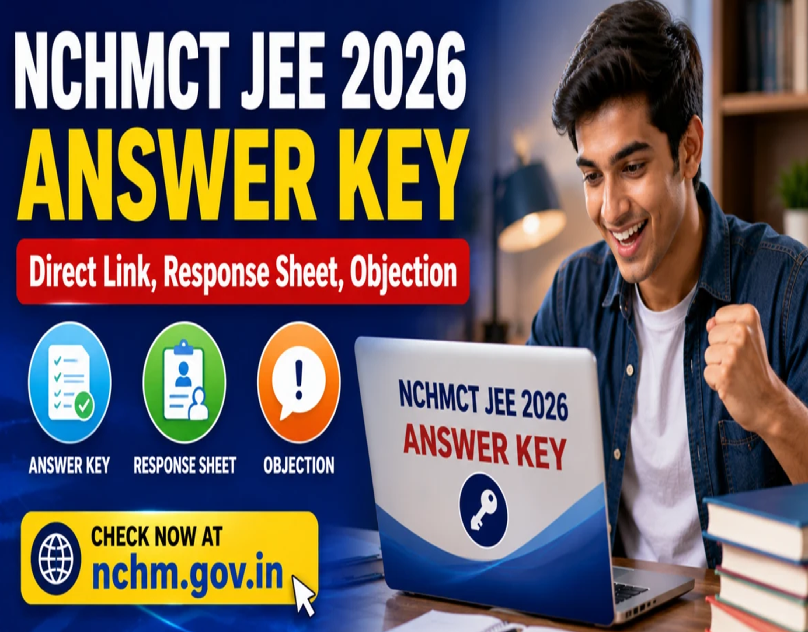
NCHM JEE 2026 Answer Key Released by NTA, Objection Window Open for Candidates Nationwide
NCHM JEE 2026 Answer Key Release Highlights the Growing Importance of Transparency in Competitive Examinations
The release of the NCHM JEE 2026 provisional answer key and response sheet by the National Testing Agency (NTA) marks a crucial phase in India’s increasingly structured and technology-driven examination ecosystem. For thousands of students aspiring to build careers in hospitality and hotel management, the publication of the answer key is not merely an administrative formality. It represents clarity, accountability and the beginning of the next stage in an intensely competitive admission process.
Candidates who appeared for the National Council for Hotel Management Joint Entrance Examination can now access their recorded responses, question papers and provisional answer keys through the official NTA portal. The agency has simultaneously opened the objection window, enabling students to challenge discrepancies in the provisional answers by submitting supporting evidence and paying the prescribed fee per question.
While such announcements may appear procedural, they reveal how significantly India’s examination architecture has evolved in recent years. The release of answer keys and response sheets has become central to ensuring transparency, reducing ambiguity and strengthening trust in national-level entrance examinations.
Understanding the Significance of NCHM JEE
The NCHM JEE examination serves as one of the primary gateways to prestigious institutes of hotel management and hospitality education across India. Conducted by the NTA, the examination facilitates admissions to undergraduate hospitality programmes affiliated with the National Council for Hotel Management and Catering Technology.
The hospitality industry itself has undergone a substantial transformation over the past two decades. Once perceived narrowly as hotel-based service work, the sector now encompasses luxury tourism, event management, culinary arts, airline hospitality, cruise operations and international tourism administration. As the industry has expanded, hospitality education has gained increasing prominence among students seeking dynamic and globally mobile career opportunities.
This growing interest has intensified competition within NCHM JEE, making every stage of the examination process critically important for aspirants. In this context, the release of the provisional answer key becomes more than a technical update; it offers candidates an opportunity to independently assess their performance and estimate potential scores before results are officially declared.
The Rise of Examination Transparency
One of the most notable developments in Indian competitive examinations over recent years has been the institutional emphasis on transparency. Historically, examination systems often functioned with limited visibility regarding evaluation methods and answer verification processes. Candidates were expected to wait passively for final results, with minimal scope for review or clarification.
The current model adopted by the NTA reflects a markedly different approach. By releasing provisional answer keys, question papers and individual response sheets, the agency enables candidates to scrutinise the evaluation framework directly.
This procedural openness serves several purposes. First, it allows candidates to calculate tentative scores independently. Second, it provides an opportunity to identify potential inaccuracies in the provisional key. Third, it enhances public confidence in the examination system by demonstrating institutional accountability.
Such mechanisms have become increasingly essential in an era where competitive examinations attract immense public scrutiny. With lakhs of students appearing for national-level entrance tests annually, maintaining credibility and procedural integrity has become a central administrative challenge.
The Objection Window and Student Participation
An important aspect of the NCHM JEE 2026 process is the objection mechanism introduced alongside the provisional answer key. Candidates who identify discrepancies may raise challenges within the stipulated deadline by submitting objections online along with documentary proof and the prescribed fee.
This feature reflects a broader shift towards participatory evaluation systems. Rather than treating students as passive recipients of examination outcomes, the process acknowledges their right to question and verify provisional answers.
The objection fee for NCHM JEE 2026 has reportedly been fixed at Rs 200 per question, a non-refundable amount intended to discourage frivolous claims while still permitting legitimate academic challenges.
Once the objection window closes, subject experts review all submitted challenges before preparing the final answer key. The final version then becomes the basis for result preparation, and no further objections are entertained thereafter.
This layered verification structure strengthens the credibility of the evaluation process while reducing the likelihood of major disputes after results are declared.
Technology and the Modern Examination Ecosystem
The NTA’s examination management system increasingly reflects the digitisation of India’s educational infrastructure. From online registrations and admit cards to digital response sheets and answer-key challenges, nearly every stage of the examination process is now technology-driven.
For students, this shift has introduced greater convenience and faster access to information. Candidates can log into portals, review recorded responses and submit objections without physically visiting examination authorities.
However, this digital transformation also carries broader implications. The modern examination ecosystem now demands not only academic preparation but also digital literacy and procedural awareness. Students must understand timelines, portal navigation, online payment systems and digital documentation processes.
For aspirants from rural or digitally under-resourced regions, this transition may still pose challenges. Access to stable internet connectivity and familiarity with online systems remain uneven across the country. Consequently, while digitisation improves efficiency overall, questions regarding equitable access continue to persist within India’s examination framework.
Hospitality Education in a Changing Economy
The attention surrounding NCHM JEE also reflects changing perceptions of hospitality education itself. India’s tourism and hospitality sectors have steadily expanded, driven by domestic travel growth, international tourism recovery and rising consumer demand for organised hospitality services.
The hospitality industry now intersects with multiple sectors, including luxury retail, aviation, wellness tourism, culinary entrepreneurship and event management. Educational institutions offering hospitality programmes increasingly market themselves as gateways to global career opportunities rather than limited vocational pathways.
As a result, examinations such as NCHM JEE have become increasingly competitive. Students view admission into reputed institutes as a stepping stone towards internationally recognised careers with opportunities for mobility and professional advancement.
This shift has also influenced parental attitudes. Hospitality education, once regarded cautiously in some traditional academic circles, is now increasingly accepted as a legitimate professional field offering substantial career prospects.
The Psychological Dimension of Competitive Examinations
The release of answer keys also carries a significant emotional dimension for students. Competitive entrance examinations are often accompanied by intense pressure, prolonged preparation cycles and high personal expectations.
For many aspirants, the provisional answer key becomes the first concrete indication of performance after weeks of uncertainty. Students immediately begin comparing responses, calculating probable scores and estimating admission possibilities.
This period can generate both reassurance and anxiety simultaneously. Candidates who perform well experience relief and renewed confidence, while others may confront disappointment or apprehension regarding outcomes.
The objection window itself introduces another layer of psychological engagement. Students carefully analyse disputed questions, consult coaching institutes and debate answer accuracy across digital forums and social media platforms.
In contemporary India, competitive examinations are no longer isolated academic exercises. They have evolved into deeply social experiences shaped by online discourse, peer comparison and collective anticipation.
The Expanding Role of the National Testing Agency
The NTA’s growing portfolio of examinations illustrates the centralisation of India’s entrance testing system. Beyond NCHM JEE, the agency conducts several major examinations, including JEE Main, NEET, CUET and NET.
This concentration of examination responsibilities under a single national body has introduced greater standardisation in procedures, digital systems and evaluation methods. The answer-key challenge model adopted for NCHM JEE mirrors similar frameworks used across other NTA-conducted examinations.
While this standardisation enhances procedural consistency, it also places enormous responsibility upon the agency. Any technical disruption, procedural lapse or evaluation controversy can affect thousands of students simultaneously.
Consequently, the accuracy and transparency of answer-key processes have become particularly significant. The ability to raise objections and review recorded responses serves as an important institutional safeguard within this large-scale examination environment.
Counselling and the Road Ahead
Following the release of the final answer key and results, successful candidates will move towards counselling and admission processes for participating hospitality institutions.
Counselling represents another crucial phase, where rank, category, seat availability and institutional preference converge to determine admissions. For students aspiring to enter leading Institutes of Hotel Management, even small variations in rank can substantially influence opportunities.
This is why the provisional answer key stage carries such importance. A single corrected response after objection review can alter scores, rankings and ultimately admission outcomes.
Candidates are therefore advised to examine the provisional key carefully, review recorded responses methodically and adhere strictly to objection deadlines announced by the NTA.
Final Reflections
The release of the NCHM JEE 2026 answer key and response sheet represents far more than a routine administrative announcement. It reflects the growing sophistication of India’s examination ecosystem, where transparency, digital access and candidate participation have become central principles of evaluation. For students, the process offers an opportunity not only to assess performance but also to engage directly with the mechanisms governing competitive examinations. For institutions, it reinforces the importance of procedural credibility in maintaining public trust. Most importantly, the announcement underscores the continued expansion of hospitality education as a serious professional aspiration among India’s youth. As industries evolve and career pathways diversify, examinations such as NCHM JEE will likely assume even greater significance within the country’s educational landscape. In that broader context, the answer key is not simply a document of correct responses. It is part of a larger system attempting to balance competition, fairness and accountability within one of the world’s largest educational ecosystems.